Monday, September 11, 2023

Open Monuments Day

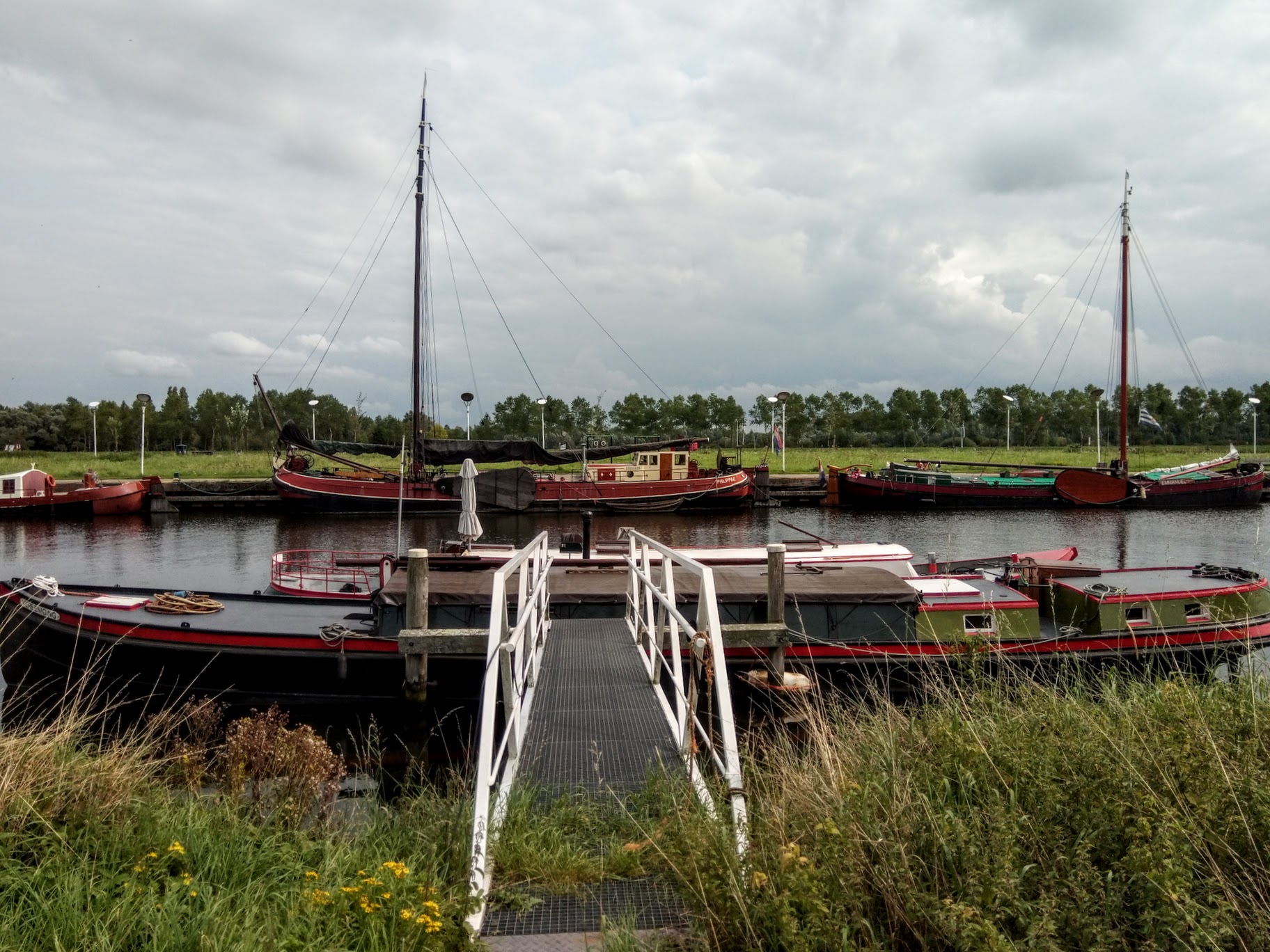
 I don't know if I've mentioned it on my blog before, but every year in the Netherlands we have an 'open monuments day' when the public get the chance to either go into historic buildings that might otherwise be closed, or get into old cars, machinery and, in our case, boats. 

Our harbour in festive mode

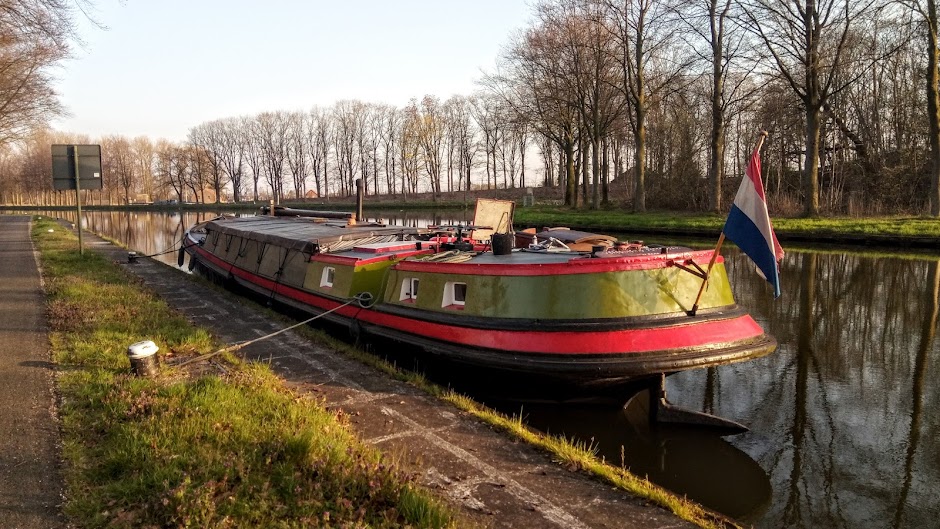
In our area, the focus is different every year. This time, it was on the historic boats in our harbour at Sas van Gent. As permanent 'liers' (liggers in Dutch), we were asked if we'd be willing to participate and be on board to receive visitors to tell them about Vereeniging and her history. At first we weren't sure if we'd be here, but once we knew we would, I set to and made an information board to explain about the history of the barge. Below is an image of what I used, although the main board was in Dutch. The English text was taped to the electricity box in case there were any non-Dutch/Flemish visitors. :)

I must admit I hadn't expected much interest, so when I saw the other boats with their bunting, I was a little sorry I hadn't thought of doing more. As it happened, it didn't matter because the organisation by the local society was very good.

It was a scorcher of a day, so they set up a table with an umbrella on the quay and directed visitors to the boats. We had several sets of people coming to see us and it was really lovely to be able to tell them more about Vereeniging's past life. The interest was genuine and the contact was very rewarding. One woman told me she frequently walked around the harbour and had often wondered about the boats, so she was especially pleased to have the chance to see them and ask questions.

Of course, the men amongst the visitors wanted to know more about the engine, so we started it and Koos entertained the eager diesel fans with stories about oily bits past and present. In her 125 years of life, Vereeniging has only had three engines: a horizontally placed paraffin engine (installed in 1898 when she was built), a single-cylinder hot bulb engine (installed in 1921) and her current two-cylinder 1950s Samofa (installed in 2006). Her current engine is still a classic and the reason for much attention for those in the know about pistons, valves and all the other associated parts. Cooling systems are always of interest, as are exhausts. I am not immune myself, as I'm quite fond of our old engine and very well acquainted with its innards.

The Current engine: a Samofa 2S108


The Historic Harbour, Sas van Gent

Anyway, by lunchtime, we were fairly well roasted and the number of visitors had dwindled. I couldn't blame them; it was over 32C in the shade and we were in the full sun. Given the situation and the fact we'd got a little dog parked under an umbrella, we decided to call it a day and retreat to cooler climes. All in all, though, it had been a great day and well worth the effort. 

Have a good week allemaal and hoping the weather gods smile kindly on you all wherever you are.


Friday, September 01, 2023

Wrapping August up in style: away days to remember

Over the past weeks of August, we've had a few really very nice away days, so although we haven't been on holiday, these trips have punctuated what has otherwise been a somewhat unadventurous summer for us. The odd thing is that we could have gone faring but we lost the impetus after the soaking weather in July and August. When we did get the chance, we didn't manage to gather ourselves together to do so. 

As a result, it's been a quiet time and one I've spent mostly doing DIY jobs at the Crumbly Cottage and on Vereeniging. So when we made trips to Leiden to visit Koos's son and Bruges to see a WOB (Women on Barges) friend, we felt quite bold by leaving our shire. We also had an afternoon out in the abandoned village of Doel, near Antwerp. Then last week I ventured even further and went to London for the day to spend time with my sister who was having a significant birthday. And to top it all, a couple of days ago, we started the Hennie H and went for a spuddle. Grand excitement all round, especially as it's inspired us to try and head for Gent (Ghent) tomorrow.

Unfortunately, I didn't take any photos of Leiden because we didn't go into the city itself. Koos's son has bought a very nice house in the suburbs and we went directly there. What made the visit even more enjoyable was the arrival of his brother, who also lives in Leiden just a short bike ride away. The drive to see him was something of a wake-up call for us rural types, however. 

We live in possibly the least populated area of the country and we were driving through the most densely inhabited part. The Randstad includes everything from Rotterdam, the Hague, Leiden, Amsterdam and Utrecht and is the industrial and commercial heart of the Netherlands. Even on a Saturday morning, the traffic jams on the Rotterdam ring road were as bad as any rush-hour. It took us three hours to do the 170 km (105 miles), which the heat of that particular day made a bit punishing. Still, it was good to see how the rest of the country's folk live—in one endless traffic queue. It served to remind me how blessed I am to have escaped it all.

Our trip to Bruges was also quite a slow one. Google told me it would take 45 minutes by car. Well, that's only possible if you run all the red traffic lights that seem to crop up every couple of kilometres along the main road. In theory, the E34 is a highway; in practice, it's a dual carriageway on which you can rarely sustain the speed limit of 90kph for more than a few minutes. Nevertheless, a visit to Bruges (or Brugge as the Flemish call it) is always lovely and we thoroughly enjoyed meeting up with the delightful Mandy and her equally charming husband, Guy. Zoe was as good as gold and settled down under the table, snoozing as we ate and chatted. 

Again, we didn't go into the city; it hums with tourists at this time of year and we've been many times before, but I love the canal that rings most of the town (ringvaart) with its drawbridges and historic gates. Our friends were moored in the Coupure, a canal that extends into the heart of the city and links to other canals that weave their way through the quaint old streets.

Boats and barges line the Coupure

Conzett Bridge over the Coupure is a special
rolling bridge that is lifted up by the cables you
can see. A Google Maps view is here

Another pleasure was an unexpected meeting with another WOB friend, Becky. She and her partner, David, were temporarily moored opposite Mandy while on their way south. I couldn't leave without saying hello, and as luck would have it Becky was on board. She and her beautiful dog, Gig, walked to the next bridge with us on our return to the car, making the day doubly special. To meet fellow boaters I've only chatted to on Facebook is just so rewarding.

As for Doel, our decision to go was something of an impulse. We've been several times over the years and it never ceases to fascinate us. I won't go into detail about its history here but suffice to say it was one of several villages intended to be sacrificed to Antwerp's need for more harbours and docks. Owing to a downturn in the economy, the planned developments didn't happen, and anyway, some of the villagers refused to leave. As a result, while most of the buildings and houses are empty and derelict, a few are still inhabited. There are still vestiges of life in this strangely appealing place on the shores of the Schelde (Scheldt) estuary, and we never fail to enjoy being there; as do many others who visit at weekends too.

Doel has a marina too, accessed from the tidal river

The sea dyke with its old windmill against the backdrop of
the nuclear power plant. Old vs new.

All the empty houses are boarded up, a magnet for graffiti lovers

Nature's art seeking to disguise man's 

Once upon a time there was a petrol pump

Another example of nature getting its own back

My trip to London was the last, and possibly most impulsive of all these away days. I'd hoped to travel on the Eurostar to London and back but only booking a week in advance, it proved too expensive at such short notice and I'd have had too little time in London as well, so I took the train there from Brussels and the overnight coach from Victoria back to Gent. Anyway, long story short, I met my sister at St Pancras and we spent the day in St John's Wood where our family lived between 1955 and 1967. 

It was a day of walking, talking and reminiscing, with the extra joy of having our brother and his wife join us for lunch. For me, time with my siblings is precious as it happens rarely, so this was a day to treasure and a perfect way to celebrate my sister's birthday.

The underground station just as I remember it

Our road: its name was apt as our
house suffered badly from rising damp


I remember coming here with my brother when he was
going through a train spotting phase.

The house we lived in until I was 12. When the lease
expired, the rents became unaffordable and we had
to leave.

When I was a child, this was a Blue Star garage. It's a listed
building now.

I love this skew telephone box. The pub on the
corner was where my eldest brother had
his first drink


My last photos for August are of our first trip out on our Hennie H a couple of days ago. We went all of four kilometres to 'visit' Vereeniging, but it didn't matter. It was Zoe's first cruise out of the marina too, so a landmark (or canalmark) event. I don't think they need any explanation, but I do love the ones of Zoe in her lifejacket. She seems totally unfazed by it.


Pondering on snacks she could have

Crossing the canal in the wake of the big boys


Hennie H and Vereeniging look lovely next
to each other

Luckily, they're about the same height

But Hennie H is visibly shorter

And off we went again, back to HH's mooring

She can stir up quite a wash

Ain't she sweet?


It can get chilly on the water


So that's my wrap up for August, allemaal. I hope September will be kind to you all. There are definite signs of Autumn on the way here, but I believe the coming week will be hot again, so here's hoping for a bit of Indian summer. Till next time and have a good weekend.


Tuesday, August 22, 2023

The great Dutch divide

The other day I was reading a blog post by a Facebook friend, Dvora Treisman, who lives in Spain. She was writing about the various festivals connected to Mary, mother of Jesus. I knew there were numerous virgin Mary churches and was aware from a marvellous book I read earlier this year that many spaniards have a deep attachment to their own district's madonna. 

The blog and the book together have led me to ponder on the individual customs associated with religion in different countries and particularly in my own Netherlands. Now, most people perceive this country as being a progressive, secular, anything goes nation, and in many respects they'd be correct. Among other notable events, the Netherlands was the first to legalise same-sex marriage in 2001; it has long tolerated the use of cannabis and marijuana; and it was apparently the first to legalise euthanasia in 2002. However, in something of a paradox and to a noticeable degree, the country is still divided along religious lines. These days the distinctions are marked more by customs than church attendance, but for someone like me who grew up in the UK and never knew what religion anyone espoused it was a surprise to encounter them here.

The first thing I was made aware of was that the north of the country, including Zeeland in the west, is predominantly Protestant, while the south is mostly Catholic. The map has become more blurred in recent times but largely speaking the dividing line is still the same. The two maps below show the proportions in the 19th century and in 2015.

By I, Dimitri, 
The 1849 situation
The green areas are Catholic


The red/pink areas are predominantly Catholic:
Downloaded from Quora: Sources from Statistics Netherlands (2016)

Clearly, there has always been some overlap, but the situation hasn't changed all that much. Where I live in Zeeuws Vlaanderen (that narrow strip bottom left), we have quite a mixed scenario. Zeeuws Vlaanderen is part of Zeeland, which is traditionally Protestant, but the areas bordering Belgium and those closer to Antwerp are Catholic. This could, of course, be purely notional as the number of people attending church services has dropped substantially, but it's still prevalent in the local traditions. 

One example is the celebration of Carnaval. Every February, Catholic towns and villages organise this three-day event with flamboyant floats, outrageous costumes and an emphasis on role reversal and social ridicule to prelude the start of Lent. If you like, it's the Dutch version of Mardi Gras, except the weather is usually awful, bitterly cold and painful grey (sorry). 

In our disputed area, the towns and villages bordering Belgium are all Catholic, including our own, so we have carnaval here. Personally, I can't imagine anything more wretched than going out and following garishly coloured (but superbly constructed) floats in such horrible weather. However, it's hugely popular and widely supported. Ten kilometres up the road, we are in Zeeland proper and it's Protestant, so no carnaval...perish the thought. 

Sourced from Wikipedia: Role reversal at carnaval is a 
common theme.


Sourced from Wikipedia: 2013 Carnaval
including social criticism

In fact, wherever you find Catholic communities, whether they are church-going or not, you will find an enthusiasm for processions and celebrations. In the more sober Protestant areas, this is simply not done, and in the more conservative Protestant towns and villages in Zeeland, strict social rules apply. Several years ago, I remember driving through one village on a Sunday and asking Koos why we were seeing so many men in dark suits and women wearing dark calf-length skirts and sensible shoes.

"This is a Protestant village," he told me. "On Sundays, they go to church and spend the day in service of their Lord. No work is sanctioned, not even gardening."
"Oh? Not even weeding? Or washing the car?"
"Not even that," he confirmed.

Later, I was teaching a girl who lived in such a village, and she told me she'd been criticised for wearing shorts on Sunday and for cleaning her windows. While I think much of this strictness has been diluted with the increase in mobility and the exodus of young families from the cities to the country, there are still numerous places where these social restrictions apply.

Oddly enough, and this is something I've only just learnt, there are religious/regional differences in language as well. These might be as minor as differing prepositions, but they are distinctive. For instance, I'm told that Protestants will say 'in de eerste plaats' (in the first place), but Catholics say 'op de eerste plaats' (on the first place). This was news to me, but it seems it crops up in other situations and in other expressions as well. 

Overall, however, Catholics are perceived as being the 'easy come, easy go' types, eager to celebrate, drink plenty and enjoy life. Protestants are culturally more sober, and although the edges of these characteristics have softened over time, they are still evident in this apparently progressive country. 

So that's my thought for the week allemaal.  I know it's a sidestep from my usual 'doings of the us-ings' post, but it's a subject that interests me greatly in this small country of mine. Are there any cultural paradoxes in your country? I'd be very interested to hear about them.

Thursday, August 10, 2023

How to keep afloat on your (little) boat

The last week has been one of torrential rain and wild wind, but at last the awful weather seems to have abated, at least for a bit. This has given Koos and me the opportunity to check on the boats and do a few much needed jobs.

One of these has been to solve the problem of protecting the Vereeniging from bumping hard against the poles to which she is moored. The canal off which our harbour lies is a busy one with massive sea-going vessels ploughing their way to and from the Ghent docks. One of the by-products of what is definitely a marvellous sight is that the wash from these huge ships flows into the harbour resulting in substantial disturbance and movement.

We learnt early on that we needed fenders to stop the bumping, which can be quite irritating. A large fender tied to the pole to the right of the gangway (looking at the Vereeniging from the land) made a huge difference.

Another fender tied to the pole to the left of the gangway prevented bumping at the bow end of the barge. So, we thought, everything was secure and sorted. Alas, we were wrong.


Now the summer holidays are here, most of the neighbouring barges have left to go cruising and the Vereeniging is more exposed to the wash of the water coming into the harbour. Over the last couple of weeks, each time we’d been to check on her (almost every day, in fact), the fenders had slipped out of place. Then, a few days ago, the front fender sheered off completely in the storm that battered our part of the country (a no name brand this time). So it was back to the drawing board. 

The first solution was to string three old karting tyres together, courtesy of my daughter's speedy hobby, and tie them around the pole closest to the bow. These have nestled neatly around the waterline and are protecting the Vereeniging nicely. The stern fender has been more of a problem, though, as it kept slipping out, so today, Koos and I bit a few bullets and took radical action.

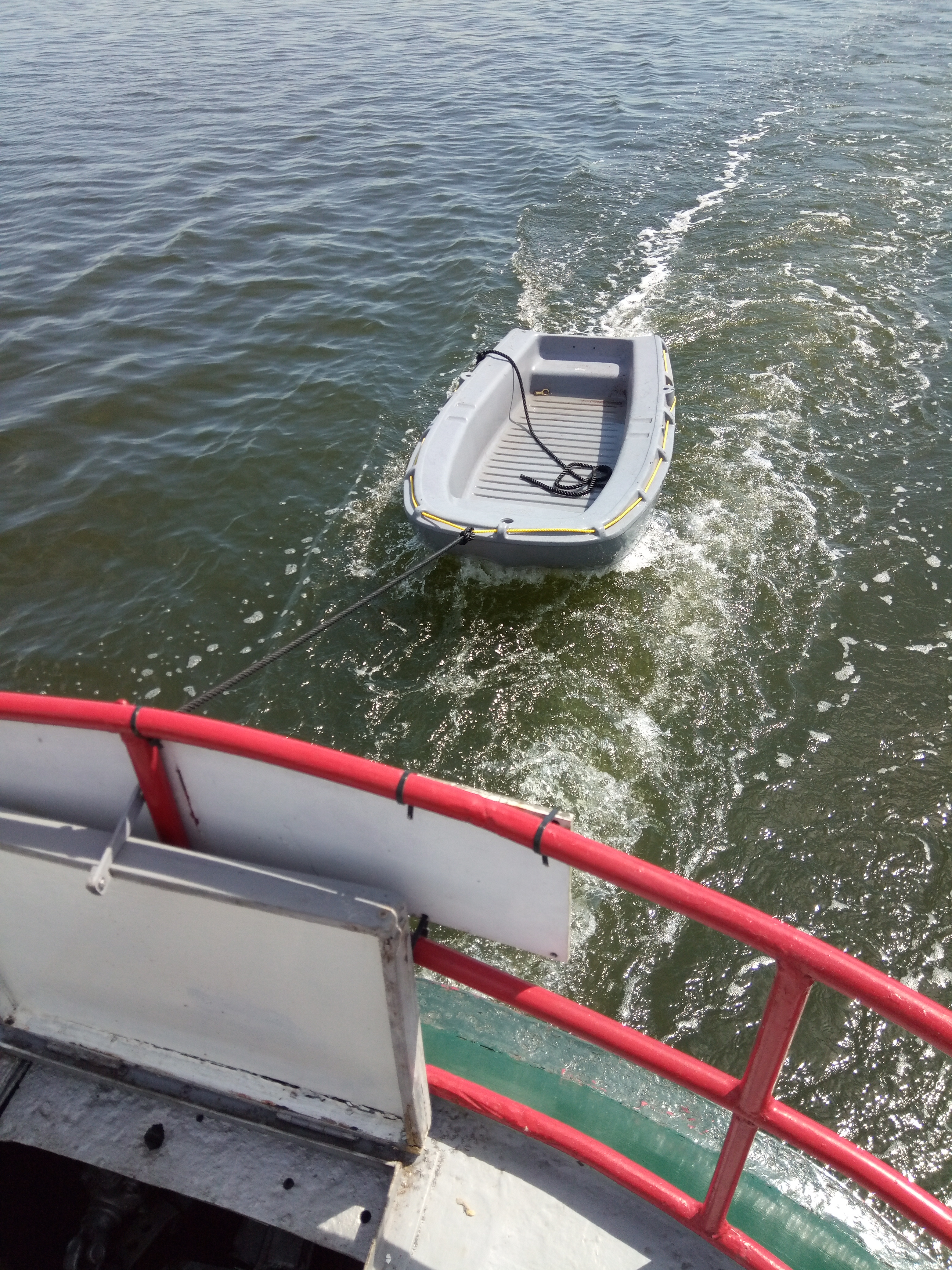
To help with access, we'd already towed our little rowing boat over from the Hennie H to the Vereeniging. Now bearing in mind, it's a very small and light boat, suffice to say it isn't very stable.

A very small boat indeed

The upside is that it was easy to drag from the car into the water and position it near the pole. The downside is that when Koos lowered himself into it, the boat acted like a skittish colt and keeping his balance while he secured the fender was similar to riding a bucking bronco. My heart was in my mouth as he clung to the pole while the boat swung in and out beneath him, but determination won the day and he managed to tie the fender in such a way it would take a major tsunami to dislodge it.

Then it was my turn. I'd noticed a nasty scrape on the hull just on the water line where the paint had come off and rust was showing through. Once Koos was safely back on board, I dragged the boat forwards, tied it to the Vereeniging and walked along the rubbing rail to climb down into it. Like Koos, I suddenly felt as if it was determined to tip me out, but I clung on and managed to kneel down so I could apply a paint and oil mix to the offending scratch. 

Getting out was even more of a challenge because I needed to stand on its edge and find my balance before heaving myself back on board. I should mention that I've never been physically agile and have had many a past misadventure in wayward small boats, when my legs have parted company with each between ship and shore (so to speak). Thankfully, Koos was on hand to help me haul myself up and a dunking was averted, but we both felt quite proud of ourselves for taking on such a physical challenge. 

I am seriously considering investing in a larger rowing boat, however. While I like a bit of excitement in life, the threat of being cold and wet is one risk I can live without.

So that's it for this week, allemaal. Plans for faring are still unclear at the moment, but you'll all be the first to know as and when. For now, we're just glad the sun has finally come out again. Have a good weekend and watch this space for more news and views from the flatlands.

Monday, July 31, 2023

A different rabbit warren to explore

Since last week, I've been involved in yet another research project, this time on a different subject altogether, but before I get into that, I'll give a couple of updates on the boat/faring front.

As most of my European friends and family are aware, summer is unofficially over; unofficially because we're all meant to be taking our holidays now and enjoying basking in wall-to-wall sunshine, ambling through the countryside on long walks, eating al fresco meals and, in my case, faring gently along canals dappled with warm sunlight between the overhanging trees. Instead, most of us have pulled out our winter woollies, found our wellies and are putting on our macs every time we step outside.

The consequence is that preparations for our departure have stalled and we'll definitely be waiting for some light at the end of the rain tunnel before we cast off. S'la vie, as we've learnt to say.

Anyway, apart from making a replacement panel for my Vereeniging's exterior (the old one was suffering from rot) and almost finishing a new hatch for the Hennie H, outside work is far too wet to contemplate. Instead, I've been busy burrowing down a new rabbit hole. I haven't finished the project I was writing about last time by any means, but I'd committed to write a piece for an anthology I've contributed to for the last few years. As time was marching on I thought I'd better get on with it, so I've made a start and, as with my other project, digging into the past has got me thoroughly distracted. 

In this case, it's my own past. What some of you may not know is that I grew up in London. Like my brothers and sister, I was born in a clinic in Avenue Road near Regents Park. My parents were living in a flat in Charlbert Court off Allitson Road, so it was the nearest hospital to their home. 


Charlbert Court

We were all born there, but being a family of six in a small flat became untenable so after I was born, my parents took the last ten years of a lease on a house off the famous Abbey Road of Beatles fame. At the time, it was a remarkably cheap option; in the post-war fifties, even St John's Wood was a place with council flats and ordinary folk. In our road, this meant that we lesser mortals rubbed shoulders with the other half, including actors, bankers and aristocracy. 

But in 1967, the lease expired and the rents for leasehold properties were set to quadruple or more. Buying or even renting in the district my parents had lived in for twenty-seven years was impossible*. We not only moved; we moved out of London completely. 

Springfield Road

For the anthology contribution, I decided to write about my memories of living in our house from the time I was three, which is when I first remember anything at all, until I was eleven in 1966. It was a unique period for a number of reasons and so I started doing some fact checking, a process that led me to a fascinating website about St John's Wood. 

The menu for the site allows you to focus on specific streets, so when I looked up ours, I was pleased to find a brief biography of the actress, Adrienne Corri, who lived down the road from us. We didn't know her, but we and everyone else in the road knew her Bassett hound, George, because he was always escaping, a fact that wasn't in her bio. 

However, I was hoping to find something about Dick Bentley, a radio presenter, who also lived there and with whom my sister and I sometimes chatted when we took our family dog for a walk. He was such a nice man. His biography was missing, which was a disappointment, but because the site invited former residents to share their memories by email, I sent off a message asking if his story could possibly be added.

The house where actress, Adrienne Corri lived is the
first white one on the right

Well, imagine my surprise when not just one, but two emails came back almost instantly asking me to write about the years we'd lived there and whether I would like to contribute something about Dick Bentley as well. I then got into email exchange with one of the writers, a woman who lived in the road that backed onto ours. She told me she'd written about her own childhood, so naturally I had to look it up.

It was such a delight to read her story. So many of her memories and experiences corresponded with and matched ours. She shared information about the local shops we all went to and the businesses that came calling; she wrote about the routines of their household, many of which were similar to ours and how children simply played in the street or in each other's front gardens. 

Nevertheless, those were the days when parents were a good deal stricter about table manners and behaviour than they are now and I laughed when she recounted how she'd had to sit for hours on her own with a plate of cold rice pudding because she refused to eat it. I had to do the same with a plate of macaroni and green beans until a lodger staying with us rescued me with a bottle of Heinz salad cream. Later, I found I preferred mayonnaise to salad cream and to this day I put it on almost all my food.

Of course, many of my memories will be inaccurate and possibly rose-tinted, but I've been chatting to my sister and in principle we agree on most things. Sadly, I cannot include all our recollections in the piece I've written as there's a word limit, but I am now so inspired I'm thinking of developing it into a full length memoir, which will need even more digging. Isn't research a wonderful thing? 

Well, that's it for this time allemaal. I don't have any personal photos to share of my old stamping ground, but those I've added are screenshots from Google maps to give some context to the post. Meanwhile, there are always boats. 


*These days, a house in Springfield Road would cost in the region of six million pounds. Yes, totally unreal, isn't it? 

Wednesday, July 19, 2023

Running down the rabbit hole of research

It's no wonder I can't get anything written these days. I started off in January with a whole heap of good intentions. Having published a book every year since 2014, I was convinced I'd have a new novel or travel memoir (or even both) out by June, but it wasn't to be.

The first thing that came along to disrupt my writing life was the delightful arrival of Zoe, the spaniel. All those hours spent walking when I could be writing, but would I exchange her for my pen? Not a bit of it. However, then came the broken wrist I've mentioned before, a more dramatic limitation than my little pooch. I have to say this really set me back a lot and it was more than two months before I could type again. Once I got going, though, another hindrance cropped up: research.

When writing about travel within Europe it's impossible to ignore history, wherever you are. I'm currently working with two books, both of which involve lots of fact checking and research, but the rabbit hole I burrowed my way into yesterday turned out to be more than usually absorbing and unusual.

I'm writing about the waterways. Well, there's nothing unusual about that, I hear you say, and you'd be right, but in this case it's led me to a whole new appreciation of that small, power-hungry, Italian Frenchman, Napoleon. Without him, the canal through-routes from Belgium into France might never have been completed. It was he who pushed for the Canal de Saint Quentin to be finished, a project that connected Paris by water to the coalfields of Belgium. It was originally conceived in the 1730s but abandoned due to other political priorities. Napoleon resurrected the scheme in 1801 and, with his drive and support, it was opened in 1810. 


The Hennie H on the Canal de Saint Quentin in 2017

Waiting our turn to enter the Riqueval tunnel in 2017

Another bit of burrowing was needed to clarify the history of the Riqueval tunnel on the Canal de Saint Quentin. The tunnel is certainly the longest currently in use in Europe and at 5.67  kilometres long (about 3.5 miles), it is quite a daunting prospect for boaters as it isn't possible to navigate it under your own steam. In fact, it never has been, but since 1910, barges and boats have been hauled through the tunnel by an electric tugboat running on a chain. This video shows  a tug pulling barges into the tunnel entrance.


It takes 2.5 hours to be pulled through, normally in convoy with numerous other boats and barges. Engines have to be switched off to avoid an accumulation of fumes in the tunnel, a precaution born out of past tragedies when, during the steam tug era of the 1860s, barge crews in one convoy died from smoke inhalation, despite the ventilation holes in the tunnel. This information was only available on the Dutch Wikipedia site and not on the English or French sites, so it took me extra time to find it in that part of the rabbit warren that is the internet.

The Hennie H in the tunnel

But digging into Canal de Saint Quentin (sorry) led me to other fascinating discoveries. This canal was just part of Napoleon's vision for expanding the watery networks. He also initiated and saw the realisation of the connection between the Scheldt (Schelde in Dutch, Escaut in French) and the Scarpe, the river that runs from Arras through Douai and beyond. The connecting canal was the Canal de la Sensée, originally Censée, between Corbehem on the Scarpe near Douai and Le Bassin Rond at the junction with the Scheldt.

Boats and liveaboard barges on the Bassin Rond 
I took this photo during a visit to the area in 2013

Finding out about the development of Le Bassin Rond and where its name originated had me diving down yet another burrow and brushing up my French to read sections of a book on the history of the Sensée canal. I was curious because there was nothing round about the Bassin Rond as we knew it, but the book explained that before the canal was widened to its current proportions, there'd been a circular basin at the junction with the Scheldt with three locks leading from it, allowing barges to turn easily from one lock into the others. The place still retains the name, despite the fact all that remains of the original Bassin Rond is the old arm of the canal that forms a wonderful lake where pleasure craft and liveaboard boats can lie. I haven't yet found out when the basin and locks were filled in, but I'm still reading. 

The current Bassin Rond 'lake', the former Canal de la Sensée
The houses alongside the old arm are gradually sinking into
the marshy land, giving them a quaint, wonky appearance

All my research has resulted in more reading than I ever intended, accompanied by frequent exclamations at what I've learned, but it hasn't prompted an equivalent amount of writing. I can so easily get lost in the fascination of the history that I sometimes think I'm more of a researcher than a writer. Will I get a book out this year? I'm not sure about that, but I'm enjoying the information-gathering process.

However, I haven't only been running down rabbit holes. My DIY projects are still in progress and I'm happy to report I've made new curtains for the Hennie H. I'm also busy making a new entrance hatch to replace the old one which has suffered irreparably from the assaults of the winter weather and I'm still chipping away at that old wall at the Crumbly Cottage. It's all designed to keep me balanced and busy, isn't it?

That's all for now, allemaal. I hope you're having a good July, whether it's a warm or a cold one. Till next time.


Tuesday, July 11, 2023

Due to Circumstances

It's been one of those months, or rather spells, when everything I've planned has been put on hold 'due to circumstances', as they say here in the Netherlands.

The first of these was one I mentioned in my last post: Zoe's illness. The poor little mite has had a rough ride, which didn't just end with her operation and obligation to wear the dreaded Cone of Shame to stop her scratching her operation wound (see last post).

First, the dreaded cone of shame

Shortly after I wrote my last blog, she developed a reaction to the antibiotics she'd been taking and proceeded to expel everything she'd eaten from both ends. Not so nice for her or me, given the numerous excursions to the outside world during the night, as well as the times she didn't make it.

An anti-nausea injection from the vet last Thursday failed to help, and in fact it simply got worse, so yesterday, I took her back again. The vet was mystified as to why she was still being sick and having the runs, and he couldn't imagine what the cause might be other than an allergic response. He gave her another injection and suggested a diet of plain pasta in small portions at frequent intervals. I should say Zoe, who loves her food, was not impressed by such restrictions at all but it seems to have done the trick in settling her upset tummy.

Hopefully, she's on the mend at last and will soon be back to normal. I've missed my little bundle of nonsense. The poor little thing has been ill for over three weeks now, but her new 'airline pillow' is a relief after the cone. She can at least scratch her ears again, which probably reduces her stress levels somewhat.


This situation, in turn, has held up other plans to work more on painting the Hennie H. However, Zoe's illness wasn't the only reason for the delay. In all honesty, it's just been too hot for painting. Half the problem with maintaining a boat is having the right weather conditions to work in. If it's too cold, the paint doesn't dry or set properly; if it's too hot, the same applies; and if it's neither of these, then it's raining. Ideal conditions for painting barges come few and far between, but we are beginning and we will get there eventually.

Meanwhile, I've been killing time by preparing to re-plaster the wall of my terrace at the Crumbly Cottage. As with every project I begin, I find it's taking me far longer than expected because there's so much more that needs to come off before I can hope to apply any cement rendering to the wall. The preparation takes patience, something I have in short supply but need to stock up on; this is a job that will not be hurried. Right now, the wall is an interesting mix of textures and hues worthy of an abstract painting, and will probably become even more so as I scrape and chip the old paint and plaster off it.


That said, the weather forecast is promising for my DIY duties over the next few days, so I'll gather up my precious pup, settle her on a cushion on deck and see what can be done to repair the paintwork on our Shoe. We're hoping to leave for our holiday in a week or so, but we can always work on the way as well.

Where are we going? I'll give you a hint. If you've heard of the film Bienvenue Chez les Ch'tis, we are aiming for the town where the film takes place. More on that next time, but for now, enjoy the rest of your week allemaal!

Here are a few prettier pics to brighten up the post: