Sunday, August 22, 2021

All decked out

 This summer, if I can even call it that, has possibly been the wettest, coolest and least helpful to a boat owner such as myself that I can remember in all the years I've lived in the Netherlands. I keep reading reports about July having been the hottest on record. Well, it may have been in some parts of the world, but definitely not here. In fact, as I see it, summer has given us a miss this year.

As a result, work on both the Vereeniging and the Hennie H has been a matter of hurling paint onto whatever surfaces I could prepare quickly between the storms and downpours. And then keeping my fingers firmly crossed that the paint will have time to dry enough before the next deluge.

In between, of course, I've had my 'wholly hole project' (aka my cupboard building exercise—see last week's post) and now I've finished one, I've started on the next one. It makes good wet weather entertainment, that's for sure, and stops me getting cabin fever.

Here's a photo of my new hole.


As for the title of this post, I did, with the sterling help of my wonderful daughter, manage to scrape and paint my Vereeniging's foredeck this last week.

If I say this is always a big job regardless of the weather, you'll understand that to do the whole thing in two days is, for us, nothing short of miraculous. It's also difficult because it is the only access point to the barge, so I did one third of it on the port side on Wednesday. Then my daughter came over early yesterday morning and we did the rest of the washing down, scraping sanding, and painting by 3 o'clock. A marathon effort, after which we were, as I've said, totally decked out. So thanks Jo!! 

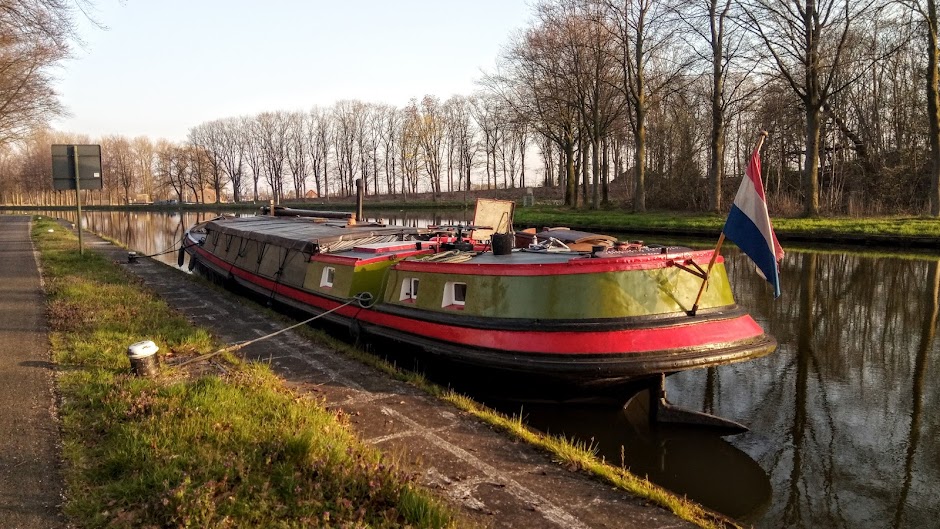
Doesn't she look smart?


I have now scooted back to Zeeland and am praying last night's rain hasn't damaged the new paint. It's best if I leave it a few days before walking over it again anyway, so I'll have to contain my impatience until sometime midweek when I'll go back again to inspect the situation.

As for the Hennie H, my hole is really the least of the projects going on there. Koos is doing magnificent things in the engine room and with luck (and maybe a bit of good weather ... please) it will all be ready for the inspector to come back and check it again very soon. The best thing is that we've heard the new engine running, and it sounds great: sweet, rumbly and very much alive.

Keep everything crossed for us allemaal. Who knows? We might get a couple of away days on board yet!


Thursday, August 12, 2021

Rotterdam's 'Ferry Harbour' or Veerhaven

In the past few months I've done a few posts about different parts of Rotterdam, so this week I thought  I'd take you to another of the city's historic harbours and one of my favourite places on our side of the river. This time, it's to the Veerhaven, which translates into English as the Ferry Harbour.

Despite the Oude Haven being the oldest of Rotterdam's inner city harbours, the Veerhaven seems much more fitting as a historic harbour, surrounded as it is by beautiful and stately old buildings that used to house merchant and shipping businesses. It lies on the north (our) side of the river, a little downstream of the famous Erasmus Bridge and Wikipedia tells me that "almost all the buildings around and near the Veerhaven are national monuments." 


The Erasmus Bridge. Looking south, the Veerhaven
is to the right of this image, behind me.

The Veerhaven was named after the ferry service to Katendrecht on the southern bank of the Maas river. Incredibly, the ferry began operating in the 15th century, and was the only means of crossing the river until the Willemsbrug (that big, red bridge in Rotterdam) was built in 1878. However, the ferry continued in service until 1968 under a company delightfully called Heen & Weer (Dutch for 'there and back'!). When the metro added a new means of transport across (or rather under) the river, the ferry was, I suppose, sadly redundant. Nowadays, the Rotterdam water taxi carries passengers from the Veerhaven across to the Hotel New York, so it's nice there's still some kind of public transport by boat over the river.

That "big red bridge, the Willemsbrug" as seen (artfully) from
my deck Oude Haven one rainy evening.

These days, the Veerhaven harbour itself is home to some wonderful old sailing craft, some of which are former North Sea fishing vessels. They have a distinctive 'tub-like' design that is quite similar to old Norwegian fishing boats. 

I really love the collection in the Veerhaven because the boats are so different from our own barges, and it's a real pleasure to walk around the harbour. The photos below are some I took several years ago, so the occupants of the harbour today may have changed, but these will give you an idea of the type of classic craft that are mostly there.


One of the things I love about the Veerhaven is its floating harbour master's office (see above). It really is a gorgeous building and has quite an interesting history of its own. Apparently it started life in 1911 as the Rotterdam River Police building in the Parkhaven a few kilometres downstream where there are commercial locks into the canal system leading to Delft. During the war, it fell into disuse and was moved to Zwijndrecht (not far from Dordrecht, and upstream from Rotterdam) where it became someone's home until 1995. It then made its final move when it was sold to the Veerhaven Foundation for the symbolic sum of a single guilder. Clearly someone thought it needed to be placed in a special context and money was not going to play a role.

I think it's time I took another wander around the Veerhaven, and when I do, I'll take some more photos to add to this post. It would be good to see it again.

On a more personal front, I've been busy on the Hennie H this week, making a cupboard out of a hole. I'm thinking of dubbing it the 'wholly hole' in recognition of its increased status. The hole in question was made in an emergency several years ago when we had a fire inside during some welding work ...ahem. We've talked for years about doing this, about making the hole useful as a whole (sorry), and at last, I've managed to get round to it. I'm quite pleased with the result and am looking purposefully at the other holes in the walls now.


Enjoy the rest of your week, allemaal, and I'll show you the finished product and hopefully another new wholly hole (to the right) next time.


Monday, August 02, 2021

A heap of old history

Just recently, I've been checking back through old posts and photos in doing some research for something else and I came across the two photos below. As most of my readers here know, my Vereeniging is a very old barge, built in 1898, and the gentleman who commissioned her was one Roelof Mur. These two photos were both originally on the website of the Mur family, who owned a well-known transport company that began life in 1784. Roelof here was one of a long line of Murs, and his ambitious purchase of two motorised barges (one of which was my Vereeniging) was a turning point for the company whose fleet had previously been horse-drawn.


The photo above is of Vereeniging when she was new, and you can see the skipper, probably Roelof himself, standing at the wheel. I also love the little face that's just visible in the window of the engine room in front of the steering. The Vereeniging was originally called Loenen Amsterdam II. She was what was known as a 'beurtschip' of the pakschuit type, meaning she had a specific route, a bit like a postal service, but for goods, not letters. She travelled regularly along the Vecht river between Amsterdam and Utrecht in the Netherlands, and was only put out of service in the 1960s when the company reached another turning point and switched to trucks.

However, the Murs were not alone in using Pakschuiten. In fact, at one time, they were very commonly seen on the Dutch canals and were to the waterways as Ford Transits are to the roads. I did a bit more digging around on the internet and came up with some other old photos of pakschuiten when they were still in use. I love these old images. They show what my barge would have looked like when it was working, and I particularly like the last one with the woman and her little dog sitting on the hatches.

The Gijsbertha, a barge that is undergoing restoration as I write

Pakschuiten both moored and proceeding along a canal

Pakschuiten (to the right) working on the Vinkeveen, a
lake and island area to the east of the Vecht which these
barges served as part of their regular routes


A pakschuit with two of its side panels out

So there you have it: a little more history about my barge and others like it. Sadly, probably because they were so common and possibly not highly prized, there are very few of them left. The Gijsbertha and another restored pakschuit called Nooitgedacht (Never Thought) are the only other two I know of for certain apart from my Vereeniging. There must be others, but they are now quite rare, so all the more reason for treasuring my old girl. Well, I think so anyway.

If anyone is interested in reading further about my barge and the history of the old harbour, this is a link to my memoirs about my life here: https://www.amazon.com/gp/product/B0957DPKHW

Have a good week, allemaal and I'll be back with more current news again soon.


Friday, July 23, 2021

The tale of two weeks

Oh dear. It's nearly two weeks since I last wrote my blog and once again the time has flown by. One of the difficulties I face now is that there's been so much going on I hardly know where to begin. I think I'll have to start keeping a diary soon. That'll be a first. Mind you, I'll probably forget to write that as well, knowing me.

I know I can't even begin to talk about the past two weeks without mentioning the horrendous floods in the south-east of the Netherlands and across the borders in Germany and Belgium. Back in March, Koos and I spent a weekend in the affected area. We were at Valkenburg, near Maastricht. I was amazed at how beautiful and hilly it was in the region, as you can read here. While there, we went to the Drielandenpunt where the borders of the Netherlands, Germany and Belgium come together at the top of the Netherlands' highest hill.

Limburg is a long, narrow province, sandwiched between equally undulating parts of Germany and Belgium and Drielandenpunt is the end tip of this sliver of the Netherlands. Added to this, Limburg is the province through which the Meuse / Maas river runs on its way to its mouth in Rotterdam. It is also where Germany's Roer river merges with the Maas. Then there is the river Geul that threads its way through Valkenburg, which lies in its valley. So, a large river valley with at least two confluences, and high hills to the east and south are just the beginning. Add to that days of torrential rainfall in the region and you have all the ingredients for a flood disaster. I was in Valkenburg again at the end of May (see blog) with my daughter and we had glorious weather then, but with all the hills running down into town, I could easily see how it might be at risk.

As things stand now, the waters have receded and the rains have stopped, but the destruction has been too terrible. Luckily, there has been no loss of life in the Netherlands; that is not true of Germany and Belgium, both of which have serious death tolls and even worse damage. It's heartbreaking and tragic, and my thoughts remain with all those who have lost everything they own in the deluge.

Gloomy skies over Zeeland

Over on our side of the country, we were spared all but a couple of weeks of miserable weather; however, nothing out of the ordinary unless you consider that it's supposed to be summer, although this last week has been lovely. I was half expecting the high waters to reach Rotterdam at some point, but it seems to have been dispersed through the country's impressive water management systems before it reached us. We feel almost unfairly lucky. 

The weather might have been miserable but
the flowers still bloom

In other news, we are still working on the Hennie H and the Vereeniging in the hopes of getting away at some point this summer. An inspection by an expert yesterday revealed we still have some jobs to do for the HH's new engine to be deemed properly installed for insurance and warranty purposes. We shall prevail, though. As things stand, travel is difficult at the moment anyway. We can't go to France without fulfilling all sorts of conditions and maybe Belgium will follow suit. Who knows? The Netherlands is officially Code Red, so we may have to settle for pottering around locally. On the upside, the Vereeniging's engine ran well in its first test this year, as did the new boiler (have I mentioned that before?). I can hardly believe it's not leaking and that the fitting went so smoothly!

There is more to say and more to tell, but I think it will have to wait until next time. The witching hour is approaching and I am ready to hit the hay. Enjoy your weekend, allemaal, and I'll catch up with the news very soon. In the meantime, here's a photo or two for you all.


Our little Hennie H still fretting to fare

I might have posted this already, but who can spot
the new window I've installed?

The peace of a local creek lake


Saturday, July 10, 2021

Rotterdam's forgotten corner


When I drive up to Rotterdam each week, I have to leave my little car some distance from the Oude Haven because I have no parking permit to put it in any of the adjoining streets. The place I usually leave it is in a neighbourhood called De Esch (pronounced 'Ess') near the university, which is something of a forgotten corner of Rotterdam, although I don't suppose the residents would agree. However, it's one of those places at the end of a tram line and it struck me the other day that at De Esch, everything is a little different. 

What makes it special is the mixture of an old harbour, waterside beaches, a wealth of green space, a nature reserve and last but possibly most, a beautiful old water tower. I've been going to De Esch ever since I first moved to Rotterdam. I used to walk there regularly with Sindy (my dog). We loved strolling through the untamed wilderness of the nature reserve where I was aware small creatures lived from the rustling in the undergrowth and hedgerows. It felt as if we were far from the city. We also enjoyed going to the little riverside beach, where I'd throw sticks for her into the water. In those days, few people went to De Esch; we were usually alone and it was, you might say, an undiscovered treasure. I could sit on the sand and watch the huge container barges ploughing up and downstream while Sindy splashed happily in the water. For me, it was a place of peace.


From a historical perspective, De Esch is also interesting. It has the oldest existing water tower in the Netherlands, which is also one of the largest. Built between 1871 and 1873 next to a small harbour, its reservoir held a million litres of water – which is substantial by anyone's standards – and the pipeline ran from the tower to the city.

Designed by one CB van der Tak, it is a meld of different styles, including Romanesque Revival and Neo-Renaissance, if that means anything to you. Whatever the labels, it's a magnificent building and a real landmark. When it was in use as a water tower, the water company workers used to live below the reservoir, but in 1986, the building was renovated and the accommodation was replaced by workshops while the reservoir itself was converted to offices. A very nice restaurant now occupies the ground floor section. 

The photo below is from the 19th century when it was still relatively new and the next one is a recent image. I pinched them both from Wikipedia, so credit goes to their website. I know I have my own photos, but I can't seem to find them anywhere, which is frustrating. Incidentally, the harbour is home to a couple of liveaboard barges, the university rowing club and a floating water taxi pontoon. It's another place I like to go and sit to watch the river traffic go by.


The water tower as it used to look
(Thanks to Wikipedia)
 

And this is how it looks now
(Thanks again to Wikipedia)

Some years ago, Koos and I walked all round the tower and behind it there are a number of rectangular reservoirs, each with its own small pump-house. I don't actually know whether they are contemporary with the tower; they certainly look the same age. I also don't know if they stored the water to be pumped up to the water tower, or whether it was a treatment works. Maybe someone reading this blog will know because I've been unable to find out so far. All the same, they are very charming and it's a fascinating place to wander around. The photo below is also courtesy of an open site on the internet. Unfortunately, the photographer's name was not given.

One of the reservoirs and pump houses. 

The other thing I like about De Esch is that the last stretch of the tram line escapes from the built-up city environs and dives into a lovely green belt that leads to its terminus. This broad expanse of grass, a veritable sward, is lined by apartment buildings, but the amount of space between the tracks and the flats gives an almost rural impression. I once forgot to get off the tram at my stop and had to stay on until almost the end of the line, but I was glad I did it. I'd never have known what a pleasant walk it was back to the university otherwise.

The tram disappears off into the green belt.
This is a screen capture from street view

So that's De Esch, an unusual but special place. In fact, I was standing where the van in this last photo is parked when I decided to write a blog about it. Is it really forgotten, though? Maybe not. You'll probably find the nature reserve, the water tower and the beach on a few 'things to do in Rotterdam' sites, but it's so far off the beaten track, mostly only locals know to go there. Being someone who avoids the 'madding crowd', I suppose that's why I like it.

 In case you're wondering, I'll be posting about the latest boat works next week. For now, here's the Vereeniging with a new coat of paint on her starboard side. Wednesday was a good day. It didn't rain for once!


Enjoy the rest of your weekend allemaal.

Friday, July 02, 2021

Sidestepping

Most readers here know that I commute regularly between Rotterdam and the crumbly cottage in the far south of the Netherlands. Now, while I try and vary my route as much as possible, I rarely take sidesteps to explore places off the beaten track, mostly because I'm in a hurry to get from A to B.

It does happen now and then, though, when Koos is with me. Since it's usually him I am hurrying to get home to, the occasions when he travels with me make for a more relaxing ride, and a bit of diversion gives the journey the feeling of a day trip rather than a commute.

Last week was one such occasion, so on the way back from Rotterdam, I mentioned to Koos that I'd never been to Yerseke before. "Well, there's no time like the present," he said, amazing me once again with his knowledge of English expressions.

According to Wikipedia, Yerseke is a "small village on the southern shore of the Oosterschelde estuary" and has a population of 6,695 inhabitants. That doesn't seem very small, but then the Dutch interpretation of cities, towns and villages has always puzzled me.

Essentially, Yerseke is a fishing town and has, predictably, several fish restaurants around its busy harbour area. It also has a row of oyster breeding ponds behind the sea dyke, so these delicacies are a great attraction for those who enjoy eating them. It was grey blustery day, though, so two things prevented us from sampling any of their offerings. The first was the smell of fish, which I can't bear, and the second was the need to sit outside. That said, others were braver and it was good to see the restaurants open again. Koos did go into one restaurant to see if he could buy some kibbeling (small portions of fish in batter) to take away, but they totally ignored him, so he left without ordering. An odd attitude given that they must be desperate to make up for lost custom during the lockdowns.

We had a pleasant walk around the harbour as I hope the photos below will show. However, our general assessment was that the most appealing parts of Yerseke are its old dock area and its wonderful, long and unspoilt beach. 

The marina dominates the main tourist spots

But this old dock area with its tidal mudflats is what I
really liked.

Low tide reveals where water exits from (I presume) the oyster
breeding ponds, but I'm not sure of that.

A closer view of the outlet.

Notice the height of the poles on which the pontoons are fixed.
High tides can be very high here, it seems.

This is real

The wide, unspoilt beach

I love the fact there are no huts, kiosks or attractions here.
The only points of colour are the bins!

 Although not a very picturesque place, we found Yerseke attractive and could understand why it's a popular holiday spot. Koos did eventually find his kibbeling at a fishy takeaway further off the main track. He pronounced it to be the best he'd ever eaten, so that's a great compliment to Yerseke.


Enjoy your weekend allemaal and hopefully the summer will return before my next blog. It seems to have given up trying for the moment.

Sunday, June 20, 2021

Camping in Valkenburg, Limburg – 'een weekendje weg'

So here it is, at last – my post about my weekendje weg camping in Valkenburg with my daughter, Mo, at the end of May. It's taken me a while to sort through my myriad photos to see which ones were worth keeping. I have to say the light was so intensely bright, many of them came out with large blocks of black and only partially visible bright areas. One of the snags of a small compact camera is there's only so much I can do about adjusting the settings to compensate for these huge contrasts.

Anyway, what I have is what you see. It was a glorious weekend and I so enjoyed spending time with my daughter and my adorable grandpup, Charlie. Mo had promised me some good long walks, something I'd missed out on when Koos and I visited back in March (see my post here), which I was really looking forward to. I arrived at her house at 5 pm on Friday afternoon and after helping (or possibly hindering) her to hitch up the caravan, we set off shortly afterwards on the 200 odd kilometres to Limburg. Even taking it slowly, it was a pleasant ride with not too much traffic and, of course, the sunshine helped. Charlie was a model passenger; we only had to stop once for him (and me) to have a wee.

Our campsite was one of Valkenburg's small satellite towns, Schin-op-Geul, both of which are to the east of Maastricht. In the screenshot below, the red arrow is Valkenburg and the blue is Schin-op-Geul.


Mo is a very competent driver (her big passion in life is karting), but even she was not totally confident about manoeuvring the caravan into position, so she drove as close to the space as possible and unhitched it. We then pushed the caravan into place by hand, aided and abetted by numerous other campers who rushed to help (or hinder) our efforts. Actually, they were lovely and it was heartwarming to receive so much enthusiastic assistance. I think Charlie's cuteness value helped as well.


What fascinated me was the whole process of getting the caravan level. I've never been caravanning before, so this was new to me. First we had to place stoppers on each side of each wheel. Then, we had to wind its stabilising feet down and keep adjusting them until the built-in spirit level showed us we were in position. This whole process took us about twenty minutes, and seemed to require much more precision that I'd have anticipated. Very different from a boat where the very idea of 'level' is complete anathema so it's a word we don't use except as an approximation.

Even after all these shenanigans, we still managed to have time to eat and go for our first walk of the weekend. It was amazing to think we'd only left at 5 and still had light enough for an evening stroll before dark – one of the many joys of long summer evenings. Even so, the dusk was drawing in and it was too dark to take photos. 

On a side note, I have to admit the night in the caravan was very cold! I was quite shocked at how frigid the temperature became. I don't know exactly what it was but it must have been in the low single figures. A very chilling experience, I can testify. My socks and fleece remained on all night, but it didn't help my poor nose which was like an ice block by the morning..


The pictures above were taken the following morning, when we took a longer walk in the woodlands nearby the campsite and ended up in the grounds of the beautiful Schaloen Castle, a chateau that dates back to the 14th century, parts of which are now used as a hotel. The current building is known to have existed since the 16th century although its fancy turrets seem to be a later development. I can't find out what the main building is used for now but it's not open to the public, which is a pity. However, the gardens attract plenty of visitors as we discovered when we arrived at the end of the drive during our walk.


The driveway leading to Schaloen Castle

We then headed to another castle where Mo knew we could have lunch. There seem to be dozens of castles in the region, which make it very appealing to history lovers, but what the Kasteel St Gerlach offered us was not only a perfect spot to have a cappuccino and a sandwich, but also some intriguing art in the park. With Corona restrictions still in place, we had to remain outside anyway, but on such a lovely day, it was no hardship.  And what a delightful place it was too. We sat in an enclosed courtyard with the other lunchers and soaked up the atmosphere and the warmth. Charlie enjoyed the fall-out from our sandwiches as well.


The art in the park was fascinating. Apparently, artists can display their work in this beautiful, natural setting and customers van view and buy whatever takes their fancy. I particularly liked these 'industrial' sculptures below, but with a price tag of several thousand euros each, I wasn't tempted to do more than admire them.


We followed up the cultural enrichment with a further walk through the beautiful grounds of the Chateau, which seemed to morph into a nature ramble. Of course, Charlie had to have his fun too, which meant some paddling and stick throwing in the Kleine Geul river. It was quite hot by now and this was his very necessary refreshment.


Our last port of call for the afternoon was to see the rock houses in the photo below. I'm not sure exactly where they are on the map or I'd post a link, but I was fascinated to see them. They weren't all that far from St Gerlach and are quite famous. Used as a museum now, they were unfortunately closed due to the restrictions, but I'd love to see inside them one day. Cute, aren't they? Very hobbit-like.


By that time, we were all walked out and so after a restorative cup of coffee, we took a leisurely stroll across the fields to the car. Back at the caravan, secondary hunger had set in, so we set up the awning and made supper outside. I did laugh, though, because the wind picked up so after having spent quite some time erecting our protective tent, we had to take it down again for fear of having it blown away. The joys of camping life! 

I think our last walk of the day was probably my favourite (did I mention the purpose was to do some walking?). We headed into the Limburg hills and had a wonderful ramble through the most beautiful scenery. I so regretted not taking my camera, because the light was stunning with the evening sun casting long fingers of gold across the fields. Just beautiful.

So that was really it. We managed another nice walk in the morning before we left, but campsites seem to be much like hotels and we had to be gone by 10 am. We got up, packed up and hitched up and then went to a nearby car park where we left the caravan while we walked. After all, it was for Charlie's sake, wasn't it?