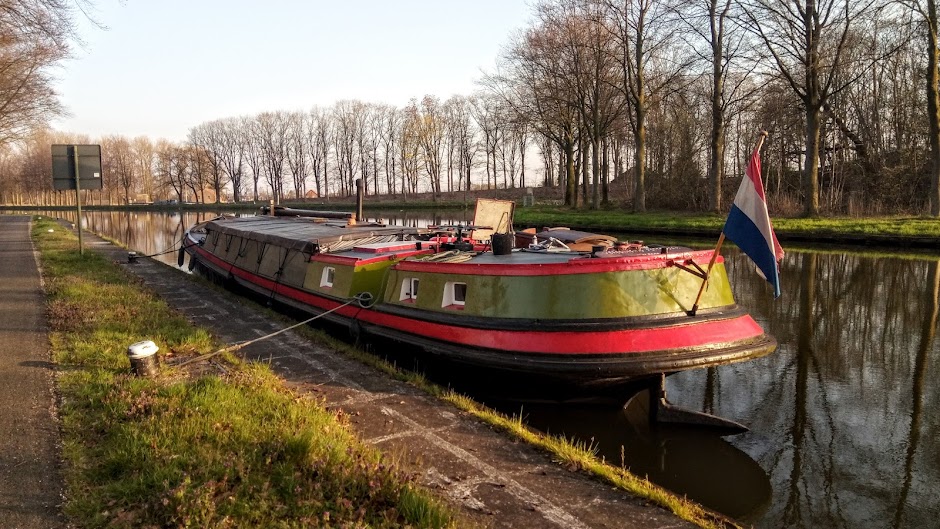
Monday, May 01, 2023

A Trip to Write Home about, Part 3: the wiggly bits

It seems impossible to think we've already been home for nearly three weeks, especially as my mind is still full of our journey. It was such a special experience and on reflection, probably the longest journey Vereeniging has ever made in her entire existence. 

Anyway, to continue the story, on the morning we woke up on the Nete Canal, we were aware that it was Saturday and we needed to cover the last 100 or so kilometres over the coming three days. I'd bought a Belgian vignet (permit) for two weeks, but because we were late leaving Oudenbosch (remember that awful weather at the end of March?), we only had until Tuesday the 11th to get back into the Netherlands before it expired. It was already the 7th. The aim had always been to arrive home on Monday, the 10th, so with our target day in view we set off along the misty, peaceful canal with fingers crossed we wouldn't run foul of inconvenient tides. 

We would meet the first tidal stretch when we arrived at the Duffel lock, which separates the Nete canal from its tidal reach, which itself becomes the Rupel further downstream at Rumst where the Dijle flows into it.


The red line on the map below shows our route through Lier to Duffel and continuing on to Boom. As it happened, the tidal restrictions made for some tense moments, the first of which came when we approached Duffel lock around 10 a.m.


"We don't know what the situation is at the moment. I'll have to ask the lock keeper if we can go through," Koos told me.
"Meaning that if it's low water, we might not?"
"Exactly. This lock can only operate if there's sufficient depth on the other side. When the tide's out, the channel isn't deep enough to let boats through. We need high water or even better an hour before high water to be on the safe side."

Koos called the lock keeper on the VHF. At first the news wasn't encouraging. He told us the tide had turned a couple of hours before and was running out to the estuary. Even worse, the next high water would only be at 8:45 the next morning.

"Well, we mustn't go if it means we'll get stuck," I said with a firmness tinged by panic. "I really don't want to take any risks. Not now. Tomorrow sounds much safer."
"Hmm, well let me ask if that's possible," Koos said. "Remember, this is Easter weekend."

He called up the lock keeper again, who confirmed our unspoken fears. The lock would be out of operation the next day, Easter Sunday. If we didn't go through today, we'd have to wait until Monday.

"You've chosen one of only three days in the year that it's closed," the lock keeper said. "But listen, there are floating pontoons at Zennegat and at Boom. You can go through the lock now and tie up on the way if the tide turns. At least you'll be on the other side and free to go when the current is with you, and anyway, you've still got time. You could reach the Schelde before low water."

Knowing there were safe havens 'just in case' made all the difference to our decision. I stopped threatening to have a hissy fit and we prepared to go through, grateful for the lock keeper's cooperation and assurance. Our descent to the river was smooth and when the double gates opened (tidal locks are often double gated), we slid with unhurried ease into the downstream current. 

Now on the river, the natural twists and turns had Koos negotiating bends with more care. The eddying waters around the bridges made for numerous cross currents but luckily, the flow wasn't too fast and within two hours we'd reached the much broader section of the Rupel at Boom.

"We can easily go through to the Schelde now," Koos said. "It never gets too low or shallow here as long as we follow the buoys."

And so we went on, the steady, comforting beat of Vereeniging's Samofa engine giving us the confidence we needed to continue. Casting my eyes over the environs, I had to conclude that the Rupel was not very inspiring; it had nothing of the wild appeal of its big brother, the Schelde (Scheldt), but it offered us a hushed, peaceful progress to its mouth, dominated by the misty skies above that the sun was threatening to dispel. The soft, whispery light and the stillness surrounding us left the greater impression. Koos took photos of objects I never even saw. The scenery was food for his camera.

When we exited the Rupel somewhere around one o'clock, the tide was still flowing downstream and it didn't take us long to realise it would be hard work to make progress against this current. Our 25 old shire horses were no match for the charge of the Schelde brigade on their way to Antwerp. After trudging along for a kilometre, we found a pontoon against which to moor to wait until the tide turned.


An hour or so later, Koos called out to me.
"Look behind you. Do you see what I see?"
At first, I didn't understand what he was pointing to, but then I saw it: three small waves. one after the other and clearly heading our way. The ebb had given way to the flood tide and we were witnessing the evidence of it rolling towards us.
We both grinned.
"Time to cast off?" I asked. Koos nodded and within a couple of minutes we were on our way, heading upstream with the current easing our passage. Even the sun was doing its best to break through the overlying clouds and the light it cast on the moored boats we passed was stunning.


It took us three lovely hours to reach Dendermonde, the place we'd decided to spend the night. The Schelde is always captivating, combining wilderness and mudflats with the human side of river life: boats, ferries, pontoons and small marinas. I love it, especially as it had the untamed element I find so appealing in tidal reaches. 

At Dendermonde, the sun came through with more conviction promising a lovely evening. We decided to bite the bullet and take a mooring at the marina, a fitting and comfortable end to the sixty kilometres we'd travelled that day. Having tied up, we looked for someone to report to and found a phone number, which Koos called.  The harbour master was busy elsewhere but told us he'd come by shortly. When he turned up, he thanked us for our honesty in calling, something he acknowledged the Dutch were particularly good about; others, he said, were more likely to take a chance if he wasn't there.  He was a friendly, chatty soul, but quite what he was doing as a harbour master, I don't know, because he he promptly proceeded to tell us all about the classic Porsche he was restoring. His enthusiasm for old cars was definitely greater than it was for old boats.


The following day, Easter Sunday, was glorious. Since we knew we couldn't leave until the afternoon (that tide again), we were blessed with a visit from one of my daughters and her partner. They came bearing breakfast, good cheer and towpath walks, but even after they left, we had to wait more than two hours for the change of the tide, a time spent doing gentle jobs in gentle sunshine. 

In fact it was four o'clock before the current stilled and we were able to leave Dendermonde to complete the last thirty plus kilometres to Gent. The map below shows this stretch of the journey, which as you can see, was full of twists and turns; the Schelde is as natural a river as can be found anywhere.


It was a gorgeous if somewhat suspense-filled few hours. We'd made two assumptions: the first being that having the current with us, we'd go much faster than our usual 8 kms per hour; the second was that owing to the first, we'd be at the Merelbeke lock well before dark. We were wrong on both counts. The advantage we'd expected from going with the flow never happened. For some reason, we were ahead of the incoming tide all the way, so our speed was disappointing. As a result, we were increasingly aware of the sinking sun as the afternoon sped into early evening, and I couldn't help checking Google maps at frequent intervals to see how far we had to go. All the same, the river was so beautiful it was easy to relish the warmth and golden glow of the spring sun.


Our relief at reaching the Merelbeke lock a few minutes after eight o'clock was palpable. We'd arrived in time to avoid having to put on our emergency lights, and we were even more relieved when a passing cruiser told us we could enter the lock ready for an early passage the next morning. Not only that, but the skipper of the commercial barge  already in the lock invited us to tie up to him, so we wouldn't have to adjust our ropes during the night to compensate for the rise and fall of the water. Such good fortune and such kindness made a perfect ending to the day. All we had to do was make sure our lights were ready for the six o'clock start in the morning and set our alarms for five thirty, a time of day I don't see very often.

The light fading in the Merelbeke lock

It was still what I consider to be the middle of the night when the lock keeper did her rounds just after six, checking on our details and our permit number. We'd barely managed a cup of coffee before scrambling outside and turning on our green and red navigation lights – the first time we'd ever used them, and, for me, my first time navigating in the dark, albeit not for long. 

The first signs of dawn were nowhere to be seen as we exited the lock. The darkness enveloped us and I stood up in the bow absorbing the new experience of faring at night. However, within fifteen minutes, everything changed and the grey light of day crept over us as we steered into the Schelde's city reaches to encounter the first of the day's disappointments. 

To cut a long and slightly tortuous story short, we discovered quite quickly that we wouldn't be able to take our normal route through Gent: all the locks and bridges were closed for Easter Monday, a hold up we weren't expecting. 

After some extensive and extended manoeuvring that highlighted Vereeniging's hopeless reverse gear rather painfully and tested poor Koos's patience severely, we managed to back out of the narrow cutting near the Brusselsepoort lock, turn around and head back to the ringvaart. You can see the detour we had to take in the map below. The blue line was as far as we got. Had we been able to continue straight on (more or less), we'd have joined the red line where it says Evergem. Instead, we had to take the red circuit line (the ringvaart) around the city, adding yet more kilometres to our journey.


The day became progressively grey, cold and blustery as we headed round the Gent's watery ring road to Evergem lock, and by the time we approached the home straight north to Zelzate, it had deteriorated still further with a strong wind blowing. I'd looked forward to this final stretch; after all, it was Vereeniging's first time along our great Gent-Terneuzen sea canal. But the weather gods had decided we'd had enough fine weather the day before so our arrival at the historic harbour, her new home in Sas van Gent, was dramatic for all the wrong reasons. 

The wind gusts were so strong as we entered the harbour, we couldn't even reach our official mooring and after being blown across the water to an alarming degree, we had to 'park up' in another spot, sanctioned by the harbour master's deputy. It wasn't quite the arrival we'd hoped for, but we had at least arrived, 8 days and 370 kilometres after we'd left Oudenbosch. Despite the disappointments the day had brought, we felt more than a little triumphant to have accomplished it.

The photos below were taken the day after our arrival. Of course, the weather was beautiful again, but it was a few days before the wind had dropped sufficiently for us to move to our official mooring.


We did it, though, and here she is, in place, in her new home and ready for some new life and adventures.


All it remains for me to say is a huge thank you to Koos for steering us so stoically and skilfully through the Netherlands and Belgium on our week-long marathon. My steering contribution was limited by my wrist because Vereeniging's somewhat stiff horizontal wheel needs two hands, but at least I could still manage the ropes, check oily, greasy bits, make coffee, cook and generally provide first mate support. Koos, however, never flagged and dealt with the old girl's old-fashioned quirks like the experienced skipper he is. On my wishlist for the future? A better reverse gear and (in my dreams) a bow thruster. Maybe one day...

I should also thank all of you who've read and followed our travels on this blog. I hope you've enjoyed the journey with us, allemaal. This is the last of these posts, so next time, I'll update you on everything that's been happening since we got home. Have a good week!


Monday, April 24, 2023

A round trip to write home about, Part 2

This week, I thought I'd show you maps with a little more detail about our route as it gets more complicated in the Belgian section. If you read the first part of our trip through the Netherlands, you'll remember we spent our third night just over the border into Belgium at a place called Bocholt, which turned out to be my absolute favourite overnight stop of the whole trip.  The photo below was taken from the other side of the canal and gives a little more context to the surroundings. As you can see, it oozed tranquillity and I'd have happily spent several days there.


However, the next day, Thursday, brought a change in the weather. It dawned grey and gloomy and after doing a couple of necessary repairs (re-packing the cooling water pump with hemp string and grease, and tightening a slightly leaky stern gland), we set off along the Bocholt-Herentals canal with a chill, damp wind in our faces. From being bathed in glowing sunshine the previous day, the flat, colourless sky put a damper on both our spirits and the scenery.

Gloomy, grey skies overhead

And then the rain came


"I'm sure this canal is lovely when the weather's nice," I remarked to Koos, trying to give a positive spin on what appeared to be a singularly dull and featureless stretch of water.
"Yes, I don't remember it being so...erm...boring."
"I'm sure it isn't, not normally, anyway." By this time, it had started drizzling. "Nothing looks good on this kind of day."
Koos nodded. We donned our wet weather jackets and I even tried holding an umbrella over our heads, but the wind threatened to blow it inside out, so I had to abandon that attempt to keep us dry.
After about fifteen kilometres of squinting into the driving mizzle (the Dutch call it motregen, which I think is a very descriptive word), I'd had enough.
"Shall we stop for a break? You could have a kip while we dry out a bit," I suggested.
Koos tried to tell me it wasn't necessary, but he didn't argue too much, so when we spotted an empty quay with a number of big bollards, he manoeuvred Vereeniging into a quick about-turn and we tied up, grateful for an hour's respite.

The map below shows our faring for the day and the place we stopped was roughly in the middle of the red line.

Day 4 began at the bottom of the V-shape on the right and
ended at the end of the arrow on the left

We lit the heater, made some hot drinks and then I indulged in some reading while Koos had a snooze. When everything so dark outside, the Vereeniging was a little cave-like indoors, but it felt a lot cosier than standing out in the wind and rain. Nevertheless, we had to move on so after something over an hour, we bit a few bullets and set off again, having already decided we'd stop after the three downward locks at Lommel and Mol, the point at which we knew we couldn't go further due to the next lock being closed. Apparently, it was undergoing repair and wouldn't be open for another week. 

To backtrack a bit, the lock keeper on the border had told us about the closure and that we'd have to turn left and take the cutting to the Albert Canal, a disappointing diversion that would add another fifteen kms to our journey and force us to follow more of the 'highway' between Antwerp and Maastricht than we'd planned. At least we knew what to expect, though.

When we finally reached Lommel lock at around five o'clock, I was feeling pretty wretched about everything. Wet, cold and miserable, I stood on the foredeck as we approached the gates, thanking everything when the lights turned green and we could proceed into the basin.

I was standing at the bow ready to throw my rope over a bollard when the lock keeper came dashing out of his office. Being the type that always feels guilty in advance, I immediately wondered what we were doing wrong. So I switched my grimace to a smile, hoping it was my best soggy grin, and also hoping an expression of goodwill would diffuse this quite obviously serious situation. 
Well, contrary to my worst expectations, nothing was wrong at all!
“This boat,” the lock keeper said, almost hopping with excitement. “It has the same name and looks of a boat in a book I have. It was in Rotterdam.”
Realisation dawned.
“Yes, it’s the same boat!” I said, laughing.
“And the writer. Her name was...”
“Valerie. That’s me.” I grinned. He grinned even more. Despite the conditions, we were both instantly delighted with each other.
“Oh, that’s amazing," he said " But what are you doing here?”
So I told him the story of our decision to move, and then he made my day by saying he had Watery Ways and Harbour Ways at home and that he’d read them both. I was so thrilled. So was Koos who had now picked up on what was happening. Who would have imagined such serendipity? My books aren’t well known in the Netherlands or Belgium because they’re written in English, so it was a huge surprise to encounter a Belgian lockie who’d read and enjoyed them. When we pulled out of the lock after it had emptied, we waved enthusiastically to him as he wished us success on our journey and scurried back into the dry haven of his warm hut.

The pleasure of this experience kept me going right through the next two locks until the rain became still more persistent. I'd stayed up in the bow to avoid traipsing through the Vereeniging's interior in my dripping gear, but enough was enough. I made my way back to Koos.

"Can we please, please stop here?" I pleaded gesturing to a quay where other boats were moored. "This just isn't fun anymore."
"Well, not right here, Vally. There aren't enough bollards and the sides are sloping, but I think I can see a wall up ahead. We'll pull in over there."

Within a few minutes, we'd found the right wall with the right bollards on the right bank, thank heavens. It was just before the junction with the canal south and we could see the lights of a lock up ahead.

"That's the one that's closed for repairs," Koos said, pointing to it. "See all the machinery? It'll reopen on the 14th."
"Too late for us," I said, a bit sadly. I'd really wanted to do that last stretch of the Bocholt - Herentals canal as it was supposed to be the pretty part. Ah well.

For once, I didn't get off the Vereeniging to take a photo, but we had a good evening and a good night against the wall. I wasn't quite sure whether we were in Lommel, Mol or Dessel, but it didn't really matter as we didn't see anything other than the trees next to the canal disappearing into an early dusk.

The next morning, Friday, was still gloomy, but it was dry and promised to be so for the whole day. We left Lommel/Dessel/Mol at a bright and early 8:45, hoping to get some mileage under our hull and be on the Nete Canal by the end of the day: around 55kms further, which would be a lot for us. We'd only done around 30kms the day before, so we'd be making up for lost distance. The map below shows where we'd intended to go (the blue line) and where we had to go (the red line)

Day 5 should have followed the blue line to Herentals but
due to a lock closure, we had to follow the red route

From my perspective, there wasn't much to recommend either the canal south to Kwaadmechelen, or the Albert Canal. The first was wide, quiet and unrelieved by anything other than bridges, each of which had its distance from the beginning carved into the stonework. Checking these helped pass the time at least, and Koos found plenty of food for his hungry camera in the industrial buildings along its banks. Here's one of his photos that I like.


As for the Albert Canal, it was something of a rude awakening. Busy, choppy and huge, I got quite shock as we entered it. I was trying to make coffee, but a passing tug made the Vereeniging rock so much I had to turn everything off until things had settled, by which time we'd reached the first of the two huge double locks we'd be passing through on this stretch. With both locks in the complex being 136m long, 16m wide and 10m deep, these are serious operations and I was somewhat apprehensive as we approached. Would they, or wouldn't they, have floating bollards? To my huge relief they did, and so tying up and descending was an easy process. Even so, they can be quite intimidating.


The first of these locks over, we covered nearly nineteen straight fast kilometres (well, fast by Vereeniging's standards) until we arrived at the second almost identical set of double locks at Olen. I think I spent most of the time following our route on Google maps, which for some reason I found fascinating, probably because the bicycle path follows the canal and I could easily check where we were, where we'd come from and how far we had to go. Koos took some more photos, but I will confess I didn't find the Albert Canal terribly inspiring; not like our Gent-Terneuzen Canal, which I love. Here's one of Koos's photos showing a new bridge and the old one it has replaced, which rests on the bank as a monument to Vierendeel bridges. Here's a link to them if you're interested: https://en.wikipedia.org/wiki/Vierendeel_bridge

The Albert Canal highway to Antwerp with an old Vierendeel
bridge on the bank

What we didn't know, though, was that the biggest excitement of the day was to come. After the lock at Olen, we had another dozen or so uneventful kilometres to go before turning at last into the Nete Canal at Viersel (see map above). For poor Koos, this supposedly innocent lock proved to be his Nemesis. Having called ahead on the VHF and been given the green light, he turned in just as the wind caught the Vereeniging and pushed her into the wall, but rather than merely thumping the side, we almost seemed to climb the lock gates before sliding back into the water. I felt, rather than saw, the crunch, and the lock keeper left his office perch to come down and make sure we hadn't done his gates any damage. Fortunately all was well and we tied up, but Koos was mortified, feeling responsible for the error. With no bow thruster and such strong wind gusts, it was pretty much inevitable, but still embarrassing for him.

But then Nemesis struck again and when we started descending, Koos's rope got caught. For a moment it seemed he couldn't free it and we started to get hung up. I rarely see my skipper lose his cool but the urgency in his voice as he called the lock keeper to stop emptying had me thoroughly alarmed. Thankfully, the water gods were on his side in his fight with Nemesis, and the rope slid out and released itself. We dropped with a bit of a thump, but it could have been so much worse and it was with great relief that we exited the lock into the peaceful calm of the Nete Canal.

We'd thought of making our way to Lier or even further, but after five kilometres a blessedly perfect quay wall appeared close to where Google told me there was an open Spar grocery. A glass of wine was in order to celebrate our arrival and to soothe any frayed nerves. It was 5.30 p.m., the end of day five and we were still on schedule for completing the journey in eight days. The next three would bring their own excitements, but for now, we'd had ours; the last hours had been quite interesting enough and it was time to stop.

A blessedly perfect quay wall near a Spar


Well, I hope you've enjoyed these two days of our journey, 
allemaal. Next time, I'll complete the story, I promise, but for now, have a great week!

Saturday, April 15, 2023

A round trip to write home about

 I know, I know. It's been getting on for a month since I posted here on my blog. The time has just flown by, but I hope a bit of quality will make up for the lack of quantity.

The main reason for my absence is that the last weeks have been taken up with planning, doing and coming down from our trip to move Vereeniging from her mooring in Oudenbosch to her new home in the Nostalgische Haven in Sas van Gent.


Old home

New home

Originally, we had a plan to head west from Oudenbosch along the Dintel river and then wiggle our way through the landscape to the mouth of the Steenbergsevliet which gives onto the Volkerak, an estuary-type stretch of wide water enclosed by two big tidal locks. From there, we would have turned left into the Schelde Rijnkanaal and followed it all the way to Antwerp, at which point we'd have taken a lock onto the tidal Schelde (Scheldt) river and headed upstream to Ghent, and then on to Sas van Gent, just over the border.

As I said, that was the plan. But plans are made to be broken and ours were disrupted completely when a good friend warned us we had to have AIS to go through Antwerp (thank you SO much, Voirrey). For those of you not familiar with this boaty world, AIS is an automatic identification system which tracks a boat's position and transmits it to other shipping in the vicinity. In the Netherlands, it is not a requirement for boats under 20 metres long, but last year, Antwerp harbour authorities decided all boats passing through the Antwerp dock areas had to have it installed, regardless of size. 

Finding this out only days before our departure meant it was impossible for us to comply and we'd have to change our route completely. Without going into extensive explanations, the map below roughly shows the route we took (the blue line) compared with the route we'd originally planned (the red line). The blue route added 170 kilometres to our journey, no meagre amount given the extra time, fuel and costs, but we loved every minute of it.


We were also delayed in leaving by the stormy weather at the end of March, so it was on an icy cold, but beautifully sunny Monday morning, April the 3rd, that we left Oudenbosch and headed east along the lovely Mark river. 

A commercial barge on the Mark


Our first excitement came far too early. We were approaching the railway bridge for the line from Rotterdam to Roosendaal.

"Do you think we'll get through with the chimney up?" I asked.
"I think so. We had it up last time we came through, didn't we?" Koos verntured.
"I can't remember exactly. I have a feeling we took it down to get out of the Oude Haven."
By this time, we were approaching said bridge.
"It looks fine from here," Koos said, and I agreed. Famous last words!
The closer we got the less certain we felt, until we reached the point when my jaw dropped open.
"Oooerr," I called anxiously, stomach clenched, and I ducked swiftly as we got beyond the point of no return. Koos ducked too and the chimney cleared the bridge by a mere whisker.
"Phew!"
"Phew indeed! I guess that proves we must have had the chimney down," Koos said. "I think I'd have remembered a close call like that!"
He was right. Had the bridge been couple of centimetres lower, we'd have lost the chimney completely and had a very chilly evening. The little oil stove inside was very necessary for the first few days of the week.

From there on, it was relatively plain, if cold, sailing for the rest of the thirty kilometres to the end of the Mark Canal where we locked through onto the Wilhelmina Canal and immediately turned right into our next surprise of the day. I couldn't help letting a little sigh escape. I'd loved the slightly mysterious appeal of the reed-lined Mark, and had mixed feelings about leaving it. After all, we'd done little of the exploration we'd hoped to do since arriving in Oudenbosch, but last year was not a good one for many reasons and our dreams of cruising in Brabant were scuppered before they'd had time to come to anything. 

The lovely, reed-lined Mark


I felt sad we were leaving it all behind, but life has changed since 2021 and I have much less need for a work base close to Rotterdam. Added to that, the cost of keeping my barge in Oudenbosch exceeded the amount I was earning from my occasional trips to do examining or the odd workshop at the university. What with the increased expense of travel on top of mooring fees, it was no longer viable, but leaving wasn't without regret. I liked our mooring and I liked the town; the only thing I knew I wouldn't miss was the willow tree shedding its abundance all over my Vereeniging for ten months of the year!

Approaching the Mark Canal

Anyway, back to the journey where we joined the canal heading south-east. As we turned the corner, I received my second surprise of the day. The Netherlands is a flat country, right? Well, not as flat as you might think. The Wilhelmina Canal begins at Geertruidenberg on the Hollands Diep and runs south to Oosterhout and then veers to the east. Up to its first lock, just after the junction with the Mark Canal, it is affected by the controlled tide on the Hollands Diep. The lock then takes the farer up to the rest of the canal leading to Tilburg and Eindhoven. What was a shock was how deep the lock actually is. I don't know its actual depth, but it is probably over five metres, maybe even seven. Having navigated that successfully, we continued on our way towards Tilburg.

By now, it was afternoon, and a glorious one at that, albeit still pretty cold and with a wind that ripped at the skin on our faces. We fared along the peaceful, pastoral Brabant countryside, through two more substantial locks (the first of which was a quite old but beautifully maintained bayonet shaped lock with its doors offset at each end) and numerous bridges until, late in the afternoon, we reached Tilburg. We'd seen one commercial barge, but absolutely nothing else: not a cruiser, not a canoe and no other commercial vessels at all. Ultimate tranquillity.

Beautiful, but icy cold!

One of the many bridges on the way to Tilburg


A swing bridge

We'd agreed this would be a good place to spend the night, and Koos wanted to try for a spot in Tilburg's own historic harbour. Well, what a lovely greeting we had when we nosed our way into the side cutting reserved for old boats like ours. We were warmly welcomed by John on his gorgeous steilsteven, and he offered to let us tie up alongside, a very kind gesture I was hesitant to accept because he had two beautiful small craft next to his barge, and I was worried that we might crush them. 

The cut was also pretty narrow, so turning round was an exercise in quiet, persistent confidence for Koos while I held my breath, praying we wouldn't hit anything, especially the pontoon where young people were enjoying the later afternoon sun. All was well, though, and Vereeniging drifted into place next to John's ship after 54kms of steady faring. Unfortunately, I couldn't get off and talk to John or his wife as my wrist is still too feeble for such acrobatics, but they were delighted to have us there and provide us with electricity overnight. Such kindness is heartwarming and we were hugely grateful.

John's lovely classic barge

Tilburg's historic barges line the Piushaven

A lovely photo Koos took of the two barges in Tilburg


The following day, Tuesday, we left at 10:00 to give the decks time for the ice to clear and also for Koos to nip to the Aldi for a couple of urgent purchases. It was to be another cold, sunny day, but with far less wind – much better, in other words. It took us most of the day to reach Helmond for a second night's stop. At the end of the day, we'd done another 53kms, been through two locks (the second being another huge one) and so many bridges, I lost count in the end. We'd also by-passed Eindhoven and were glad to moor up before the lock at the end of the old canal that goes through Helmond itself. This was familiar water now, as Koos and I stayed at the same place back in 2005 when we were on our way to a festival in Belgium. 

Yet another bridge


Mooring above the lock in Helmond


We both slept like babies that night. Fresh air, constant activity for me going down, through the boat, and up onto the foredeck to do the ropes, make coffee and prepare food ensured I was good and tired when we hit the hay. For Koos, it was the concentration of steering and manoeuvring, sometimes in difficult circumstances with lack of space and the wind against us. 

It was a satisfying feeling, though, so when we set off in much warmer sunshine the next day, we thoroughly enjoyed our progress along the Zuid-Willemsvaart, the canal we'd followed so many years before. It was warm, the sky was cobalt blue and the locks (all seven of them) were a dream. A road runs alongside this canal all the way to the Belgian border past Weert, but far from bothering us, we enjoyed the occasional waves and toots from passing lorries. In fact, it was much lovelier than I remember it being from our previous trip, but maybe the relief of having a warmer day has coloured my impressions.

Sunny and warm: look, no coat!

You can just see the road alongside the canal


Industry at Nederweert, just outside Weert


The outskirts of Weert

Folly? Clock? Who knows. The time was wrong
in Weert whatever the case


My favourite mooring of the whole trip; hence, it's become my banner photo everywhere :)

As the sun sets, the lock lights remain...just.

We finished the day at Bocholt, just over the border, 40kms from our mooring in Helmond. The time spent on the water was the same as the previous two days, but we'd passed through many more locks (eight in total) and they always take time. At the first lock in Belgium, the lock keeper was there to take our details, ask for our permit number and check where we were heading. A thoroughly nice chap, he praised us for having all our paperwork in order, a surprise for us, given that we'd never dream of trying to go through Belgium without a permit and the right documents. But, apparently, people often do and it gives him a lot of administration hassles. One lock later, we were already in Val heaven. Belgium is so different from the Netherlands: less orderly, more natural, and to my mind, more appealing. We stopped above the lock at Bocholt, tied up and went for a walk. What a lovely spot it was: blissfully peaceful, and yet with commercial barges passing until quite late in the evening. I could happily have spent more time there.

So, folks, that's the first three days of our trip. From Bocholt on, things were different; there was also a moment of wonderful serendipity that made my month, so I'll leave the rest of the story till next time.

Enjoy the rest of your weekend, allemaal, and have a good week! It's great to be back and I'll catch up with you all in the coming days.

Friday, March 17, 2023

Absence makes the blog seem dearer

It's been a few weeks since I've felt able to write a blog post, and I have to admit I've missed it, as well as reading all my blogging pals' posts. 

As I mentioned in my last blog, one-handed life takes on disproportionate difficulties, the worst being that I've had four online writing courses to keep up with. Of course I don't have to produce papers and assignments myself, but I have to give feedback on everything they do, plus answer questions, give advice, counsel them on their emotional and psychological issues with keeping deadlines, wipe their...no, sorry, I don't mean that, but you get my drift. I sometimes feel like a guidance counsellor as well as a writing skills teacher. And all of this with one hand. I'm exhausted... 😆

And then there's the mounting dust in the corners being exponentially inflated by dog hair (I thought spaniels didn't shed – I was wrong), a problem I'd forgotten about. When my beloved Sindy passed on eight years ago, it was a good two years before I stopped finding her hair trapped in folds, under mattresses, and in the weave of my rugs. Now I have a small golden mutt whose hair is providing cohesion for dust bunnies gathering under the table and in the cracks between the floor boards. Hoovering is quite a mission with one usable arm, I can confirm, so I've been postponing it. And it shows. I get tired just looking at it. 👀 😄

Sindy

Zoe

So the time and opportunity for blogging and social media in general has been quite curtailed. However, in a more exciting vein, and leaving aside all the maintenance, gardening and boat work I haven't been doing, in two weeks we'll be setting off to take my Vereeniging to her new home. It's going to be an adventure, that's for sure. I'm hoping my wrist will be more functional than it is now, but luckily, there are only four locks in the entire 190 km trip, so we'll manage, I'm sure.

Now we are gathering necessary equipment, fuel and supplies. The only uncertainties are the weather and the tides on the Schelde, but we have timetables, phone numbers and names, thanks to my lovely friend, Voirrey Johnson, whom we might even see coming the other way. It will be a journey for the records, and worthy of a blog post or two, at least.

Home for the last year and a half. I won't miss that tree!

Enjoy your weekend allemaal. I hope it's a good one for you, and I'll be back soon!