 |
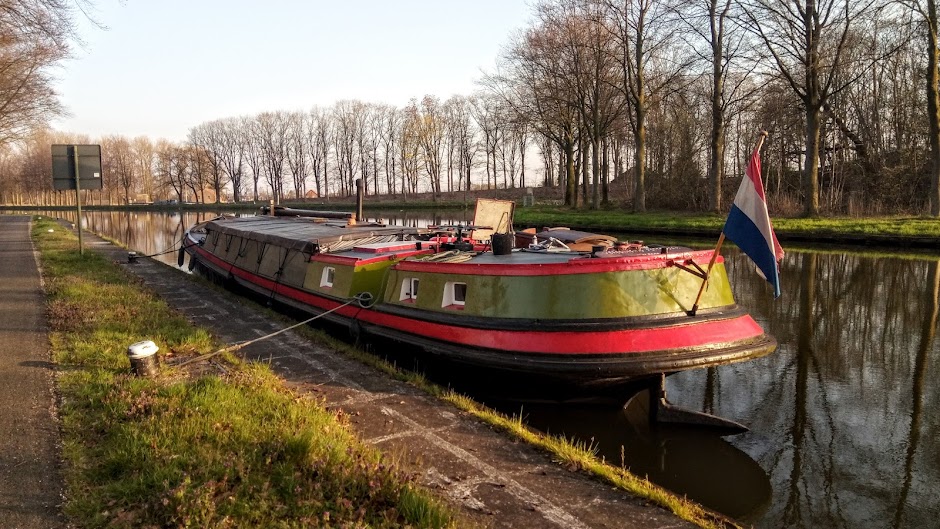
| Koos's father's barge. Mother stands in the wheelhouse door |
One thing I hadn't thought about when I wrote my last post about Who is The Skipper's Child? was something Anne Mackle mentioned in her review of the book, and that is that there is no bad language in it.
Some people might find this unconvincing, but in fact it is totally authentic. In the story, it is clear that Hendrik Kornet and his family are Protestants and make this quite plain to those 'heathen Catholics' in Belgium. In the Netherlands of the time, the country was quite clearly defined by its religious leanings: the north tended to be Protestant and the south Catholic (and to quite an extent, this is still the case although there is a large 'bible belt' in Zeeland that runs right through to Zeeuws Vlaanderen, close to the Belgian border).
 |
| A closeup of the wheelhouse. Koos's grown up brother still in white shirt and tie! |
Koos's parents were very much of the Protestant persuasion and quite strictly so as many skippers' families were. 'Bad' language of any kind would not have been tolerated on board and so no, there was no swearing or cursing even under duress. It is also true that their entertainment was hymn singing round the harmonium and they did not really mix with people outside their Protestant skippers' world. So my portrayal of the family as being rather innocent and isolated from the world is an accurate reflection of what their life was like (so Koos assures me). Being Protestant set you apart from the Catholics,who were regarded as being frivolous and given to excesses of drinking, eating and partying. Funny to think of now, isn't it?
But the twains did somehow meet now and then. I love this anecdote Koos tells (not in the book) about his father's meeting with a Catholic skipper one Sunday back in the day. The skipper, who I think was Belgian, was moored under a bridge and was busily cleaning his barge. Koos's father, who was quite a tease and not completely intolerant of other men's ways, ribbed the man for working on the Lord's day. The Catholic skipper was totally undaunted and quick as a flash pointed to the bridge above him and retorted that 'what the Lord couldn't see wouldn't hurt him'. Precious, isn't it? And maybe a tongue-in-cheek confirmation of the difference between the two...
So that's why my story is so more than usually 'clean'. It's not only that it's mainly targeted to young people, although that's obviously a consideration; it's just that their life was like that. It really was a different and insular world, and that's why I find it so fascinating.
The prequel is in the planning as I want to write about Arie's father's life during the war. That one will not be targeted to a YA audience but I will still focus on authenticity!
The Skipper's Child is on Amazon if you fancy giving it a try :)


