Monday, August 24, 2015

Liège…or Luik…whatever it is, it's lovely

One of the advantages of seniority is cheaper or free public transport. In Belgium, this applies to anyone over 65. Train travel is an amazing knockdown price of €6 for a day to anywhere in the country and that's single, return or whatever you want to do with it. Very tempting, isn't it?

Weekend tickets are also 50% cheaper for those under 65 like myself, so Koos and I took advantage of being so close to the Belgian border by driving the 20kms from our getaway in Zeeland to Ghent and taking the train to Liège. Or Luik, as the Flemish call it, but since it is a French speaking city, I'll stick with Liège. By the way, for those who are not sure where it is, think of a slightly southward sloping line east of Brussels. This actually surprised me as I've always thought of Liège as being northern Belgium. I suppose that's because it's not very far from Maastricht, Holland's southernmost city, and I tend to forget just how far south that is. Anyhow, I've never been there before and for Koos it was a long time since his last visit, so it felt like a real adventure.

Our train was a fast one but it still took an hour and forty minutes to cover the 156 kilometres (according to Google maps). We left at around 09:25 and arrived at Liège-Guillemins station just after 11:00. Being quite new and famous for its architecture, the station buildings were something I was looking forward to seeing, but in a way, they were a little disappointing. I can only liken it to a highly photogenic person. The reality is not quite as impressive as the images made of it. All the same, I liked this snap I took with the train's red doors as a sort of focal point.

Liège Guillemins

Having 'done' the station, I asked Koos where we should go first. As usual, he said 'the river', and as usual too, I was happy to oblige. We left the station armed with takeaway coffees, and headed towards the waterside. As we walked, a young man set the spirit of the day by wishing us 'bon appetit' and a very 'bon jour' with a huge smile on his cheerful brown face.

The Maas that ends in Rotterdam flows through Liège as the Meuse, and I have to say its environs here are much more beautiful. Liège is surrounded by thickly wooded hills that give a dreamy backdrop to this lovely river.
Hills around Liège

The mighty Meuse

Pont de Fragnée
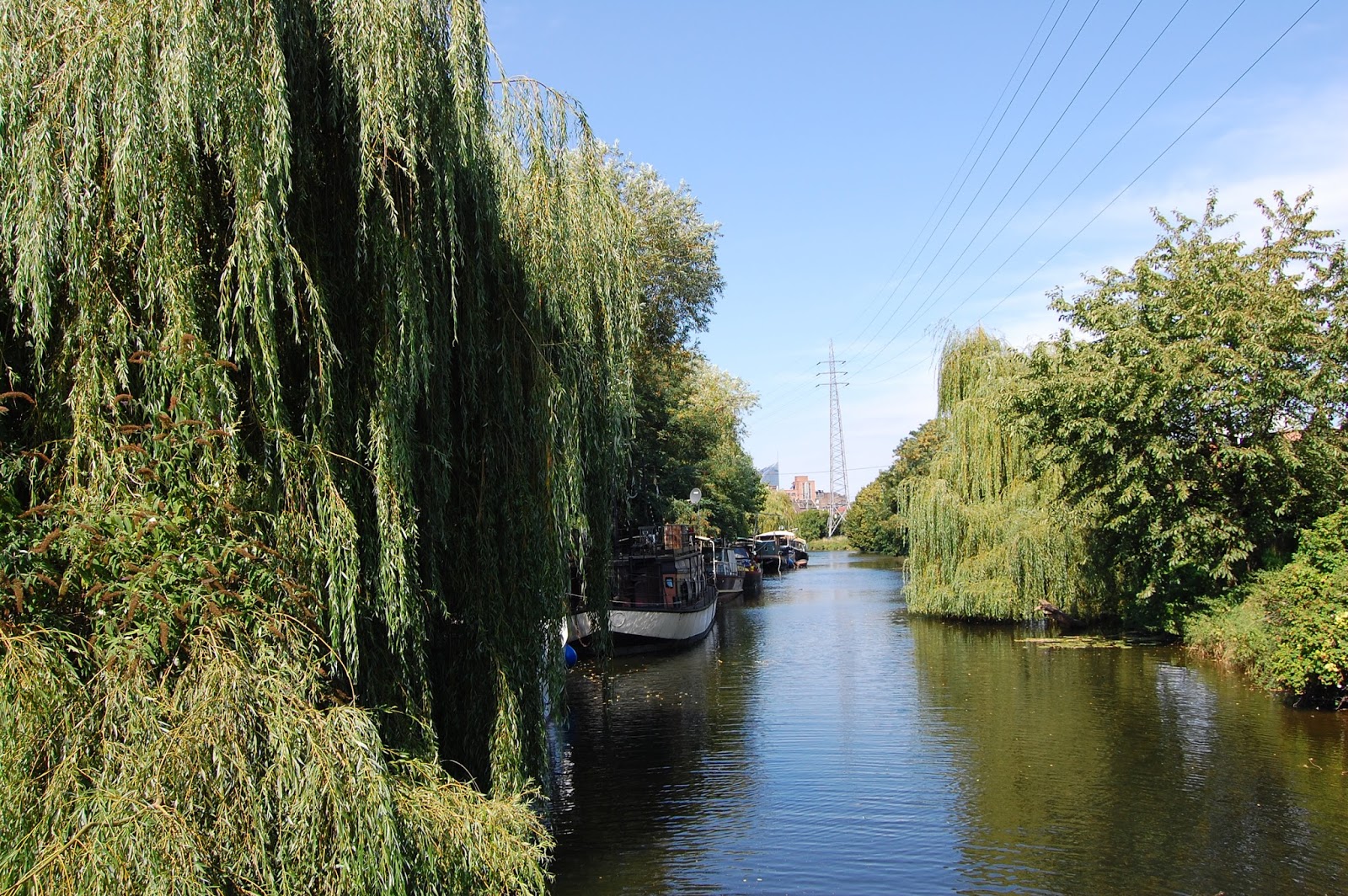
After watching a couple of huge barges pass, we wandered over the Pont Fragnée to see the lock where the old, disused Canal de l'Ourthe joins the Meuse. Koos told me there were moorings in the cut behind the lock gates, so of course we had to go and see these. One step led to the next and before we knew it we'd walked about a kilometre along the canal to the end of the moorings. The stretch where the boats and barges lay was so pretty, the taking of numerous photos was of course obligatory.


The pictures of the moorings speak for themselves, but what might not be apparent is that the level of informality was almost the greatest part of their charm. Several of the boat dwellers have made tiny gardens on the banks with pots and plants overflowing with flowers, so while maintenance might not be high on their list of priorities, the permanence and homeliness of their moorings clearly was and is.

Lifting bridge marking the end
of the moorings

Just beyond this attractive lifting bridge, we dived into a side suburb in search of some coffee. It was now well past midday; it was hot; and we needed a drink. At the end of a quiet side street, we found a bar with tables on the terrace. These were full, so we stepped inside - a lucky decision as it turned out. 

At the bar was an older gentleman with a more than passing resemblance to Father Christmas. We got chatting to him and with a mixture of French, Flemish and English, all admittedly a bit sloppy due to his somewhat inebriated state, he told us he was a local who had been customs and excise officer in his working life. We had a wonderful time with this spontaneous and colourful man. We discussed culture, language and the history of Liège with great aplomb and not much accuracy, but all in good fun. He claimed to speak the local dialect, Wallon, as well, but we didn't get a demonstration of this. Nevertheless, he, like many other Wallonians, said he preferred speaking English to Flemish, and he was audibly better at it. 

He bought us a drink and we returned the favour. But then, remembering we only had a few hours, we made our apologies and got up to leave. He kissed my hand in true gallic style. I melted. And then he told us that if we came back we should ask for Père Noel - that's what everyone called him. Coincidence, we wondered? Then we looked at his beard. Probably not.


Père Noel, deep in conversation with Koos
In a way, this meeting was the highlight of our day and further confirmed our experience with French speakers in Wallonia. From our perspective, they have always been open, lively and friendly: ready to greet us in the streets, ready to chat and share a joke, they are a pleasure to mingle with. Our earlier encounter with the young man outside the station and then with Père Noel just underscored what we already believed.

Back out in the sunshine, we continued our walk along the lovely willow-lined canal until we reached the next bridge, from which we could see the Ourthe river running parallel to the canal. Realising we'd now walked quite a distance and that we'd have to do it all in reverse, we crossed over the bridge to see something of the real Ourthe. It was much wider than I expected, but not navigable, but there was a barrage a few hundred metres on, which we decided to make the end point of our walk. This was an interesting construction of dams and breakwaters, and I was fascinated by the way the seagulls were using the breakwater stones as sun loungers.


Sun loungers for seagulls
By now, it was getting close to mid afternoon, and we'd been warned that the weather would change. Sure enough, clouds started gathering, so we walked much more briskly back, this time along the river Ourthe, which was another lovely stretch, but more formal and less given over to nature than the canal. We didn't have long to linger, though, as the first drops of rain started as we hurried back over the Pont Fragnée.

At this point, we realized we'd seen nothing of the city centre. Under our umbrella, it didn't take long to  conclude we'd like to come back anyway, so we agreed to give Liège proper a second visit at a later date to do it justice. We'd had a very special five or so hours doing what we loved in a wonderful and different setting.

A quick dash back to the station and we just made the four o'clock train. We didn't even have time to grab a cup of coffee much to my disgruntlement. Still, we'd timed it well. The rain battered the train carriages as we sped back across country, and we arrived in a damp, but lively Ghent sometime before six. The downpour had stopped and a vague watery sunlight peeked through the clouds. To finish off the day in proper style, Koos drove us to the banks of the old tidal Scheldt (Schelde). It used to run through the city, but its course is now blocked off because a new by-pass was cut. I'd read about it, but not known exactly where it was. These days, this now lonely stretch is heavily silted and quite overgrown, but at high tide, the water still flows up to the sealed lock. Yesterday evening, it was low tide, so the accumulated mud flats were exposed giving it a special sense of real wilderness. 

Mud flats on the tidal Scheldt looking towards the
old Gentbrugge lock
This was, for me, a beautiful and fitting way to end our day out courtesy of the fabulous Belgian rail system. Thank you NMBS (Belgian Rail). I think we will most certainly be back.

Saturday, August 15, 2015

The Wishing Shelf Awards - not just any old award!


I was going to write another post about our Romanian adventure, but I'm breaking it here to say something about an award I've taken part in for three years running now and really value. This is The Wishing Shelf Awards, run by Edward Trayer.

Edward publishes children's books under the name of Billy Bob Buttons - very successfully, I might add. He has won a number of awards himself for his books, one of which was The People's Book Prize. He started the Wishing Shelf Awards a few years ago as a way of providing the type of award he felt would be really useful to authors. The background, structure and costs for entering the WSA can be found on its website, so I won't go into all the details here, but it's probably worth mentioning that the entries are limited to 300 books a year. Edward says that about 50% of the books submitted are turned down.

What I mostly want to say, though, is why I like entering the awards so much. Firstly, they are aimed at independently published authors, e.g those with a small indie publishing house or self-published authors. Secondly, the books are judged by readers and not panelists. In other words, the target audience. This is something I really appreciate. Edward's team includes reading groups in both Sweden (where he lives) and in the UK and the books are circulated amongst them. My last entry was read by sixteen men and women, and there was a really good range of ages.

What's amazing is that every book (and that's a lot now) accepted for entry is read and given feedback on a number of criteria. Yes, every single book! If the author chooses, this feedback is passed on, so regardless of whether he or she reaches the finals, the entrants can gain really impartial and valuable insight into what the readers think of their work. I think this is fantastic. I know they aren't professional critics, but who better to judge than the public who would (you hope) read your books anyway? But what I like as well is that the awards also give some marketing support in the form of stickers, logos, reviews on Amazon and Goodreads, and advertising to those who make the finals. And even those who receive good feedback but aren't finalists can have the reader's quotes put on Amazon and Goodreads as a review.

I know this sounds like I'm advertising the WSA, and yes, in a way I am. But that's because I really am impressed by what these awards offer to indie writers. It's often hard to get unbiased views from readers, and we all know how difficult it can be to get reviews until we've built up a following, so the WSA is doing something I feel is really worthwhile. The first time I entered, I won a silver award for my YA book, The Skipper's Child. Last year, I entered my Eccentrics in the adult fiction section. It didn't make the finals, but I got great feedback, some good quotes and a 'Red Ribbon winner' title on the basis that 99% of the readers were positive about it. So I was actually pretty happy. This year, I'm entering the non-fiction section and I'm really looking forward to seeing what comes of it next spring.

So now I've gone on a bit about the feedback, what have I learnt from what I've had? Well one thing I know is I've got to go for more commercial covers for my books. I've got my own ideas about what I like, but I realise now that they aren't what the majority of today's readers find appealing. If I want to reach a wider audience, I'll have to think about this. The second learning point was about the plot for my Eccentrics. A few readers said it wasn't strong enough, so I need to look at that more carefully for my next novel. On the plus side, the reading groups gave me good points for the characters, the humour, my writing style and editing, so I'm really pleased about all of these. But I'll need to maintain them too!

If anyone is thinking of entering after reading this, have a look at the website first and see what the options and conditions are. Then go for it! It's a great scheme and a great support for writers (note: there's a Facebook page and Twitter as well), so huge thanks to Edward Trayer for both conceiving and setting it up. Long may it last!

Friday, August 07, 2015

Romania part 2: Timisoara, romance in Romanian form

Continued from previous post:

Waking late the following morning, we left our lovely air-conditioned Pension Yellow (a hostelry to be recommended), and ventured into a still, silent Timisoara by tram. Hardly anyone was about, which puzzled us. It was a very hot day, but hardly siesta time. Along the towpath of the Bega canal, we studied our surroundings. Beautiful, elegant, shabby chic buildings predominated. Decay rubbing shoulders with finery. I absolutely loved it. I captured a colourful family leaving their house - colourful as in the fabrics of their clothes. At first I thought they were muslim until I saw the rich, chaotically vibrant colours of their full skirts and the simple headscarves on the older women instead of veils; none on the teenage girls' heads. Roma perhaps? They looked too beautiful to me.

The situation of the Roma is not one I want to discuss here, but this article  from 2003 sheds some light on their position in Romania. It is not a happy one. Needless to say, we encountered many of them, some of whom were begging, but those that weren't seemed proud and dignified as in this family in my photo.


One of the things that charmed me in both Cluj Napoca and Timisoara was the coffee machines to be found everywhere. Nearly every small shop has one, and they can even be found on the streets. I have to say I found this immensely civilized, especially as hotel and hostel rooms don't provide kettles the way they mostly do in England and South Africa. My ability to wake up in the mornings is in direct proportion to the amount of coffee I can consume, so these machines were my life-safer. And it's astonishing that they aren't vandalized at all - something for which Koos was deeply grateful as he had to live with me until I'd had my required quota. Not an enviable task.

Each morning of our stay in Timisoara, we headed for the corner-shop-with-the-coffee-machine at the end of the street. It was run by a Serbian man (the borders with Serbia and Hungary are not far) who greeted us with a friendly smile. He learnt soon enough that firstly, we wanted coffee, secondly a hand of bananas (our breakfast) and thirdly a couple of the hugest tomatoes I've ever seen (mid morning snacks). This didn't require anything challenging in communication, but as it happens, Romanian is sort of doable in small chunks. Many of its content words are latin based, so if you know any French, Spanish or Italian, (or Latin of course), there is much you can figure out. The problem is the links that form the chain of a sentence. Totally incomprehensible to the newcomer.

Shabby chic and elegance
Actually, apart from the unarguable elegance of this lovely city, two of the most memorable moments of our stay were classic examples of miscommunciation. Walking into a canal side café, Koos saw two women eating what looked like sausage and chips. 'That's what I'd like', he said to the waiter, 'what those two women are having'. The waiter promptly brought him a pint of beer. We hadn't even noticed what the women were drinking. 'Thank you, but I'd really like what they are eating too,' he said, accepting the beer without comment. 'Do you want it with cheese or garlic?' The waiter asked. 'Oh, er, cheese, please.' A plate of chips then arrived with grated cheese over them. I started giggling 'Yes, but could I have the sausage too? Like those women had?' Koos said with considered patience. Again the question 'cheese or garlic?' Odd, but okay, garlic this time. The waiter brought a bowl of garlic sauce. Clearly the 'age' on the sauce didn't get through.


Decay rubbing shoulders with finery

The lovely Bega Canal

Gorgeous architecture

Later, Koos tried again at a kiosk. 'Could I have some chips, please?' He asked slowly, carefully. 'No, we don't sell chips, we only sell real food,' said the woman. After some experiments with the permutations of what chips might be in Romanian, he eventually got some ready-made (even to the box they were contained in) microwaved french fries. I laughed all the way into the city. What with his ageless sauce and non-food chips, it was surprising we managed to get any food at all. Come to think of it, food wasn't high on the list of memorable items. The tomatoes were amazing though!

A fine city given over to a café society

On a more serious note, I was happy I didn't see any stray dogs in either Cluj or Timisoara (something that Romania is known for), but not so happy about  the number of clearly impoverished old people. This was terribly sad, and I wondered what kind of safety net there is in Romania for old people who have no family to care for them.

Seen too often; impoverished elderly people scratching
a living on the streets

Although we went into a tourist information office where the woman on duty went to great trouble to give us a map and directions to museums, we didn't do any of the tourist sites except the magnificent orthodox churches. We like churches (Koos loves to take photos of fine church interiors) and they were blissfully cool. In Romania, the churches and cathedrals are breathtaking: so rich, so ornate, they are truly places of wonder. The people are visibly religious too. We were especially charmed when a skateboarding youth, complete with baseball cap on backwards made a sign of the cross as he passed in front of the cathedral, and many other individuals strolling with friends or family did the same.

The beautiful orthodox cathedral in Timisoara

The helpful woman in the tourist office also told us the reason the city was so quiet. It was just too hot to be out. We could understand that. With temperatures over 40 degrees in the sun, it was rather taxing. Nevertheless, at night, the city came alive. From around 8pm onwards, families thronged the lovely squares. We spent some very happy time sitting on the steps of the Opera House, just people watching. A couple of small children were playing near us, and they were such a delight to see. This was at around 10:30pm when everyone seemed to be out with their children and pets.

What fun it is to be a small boy

And a small girl

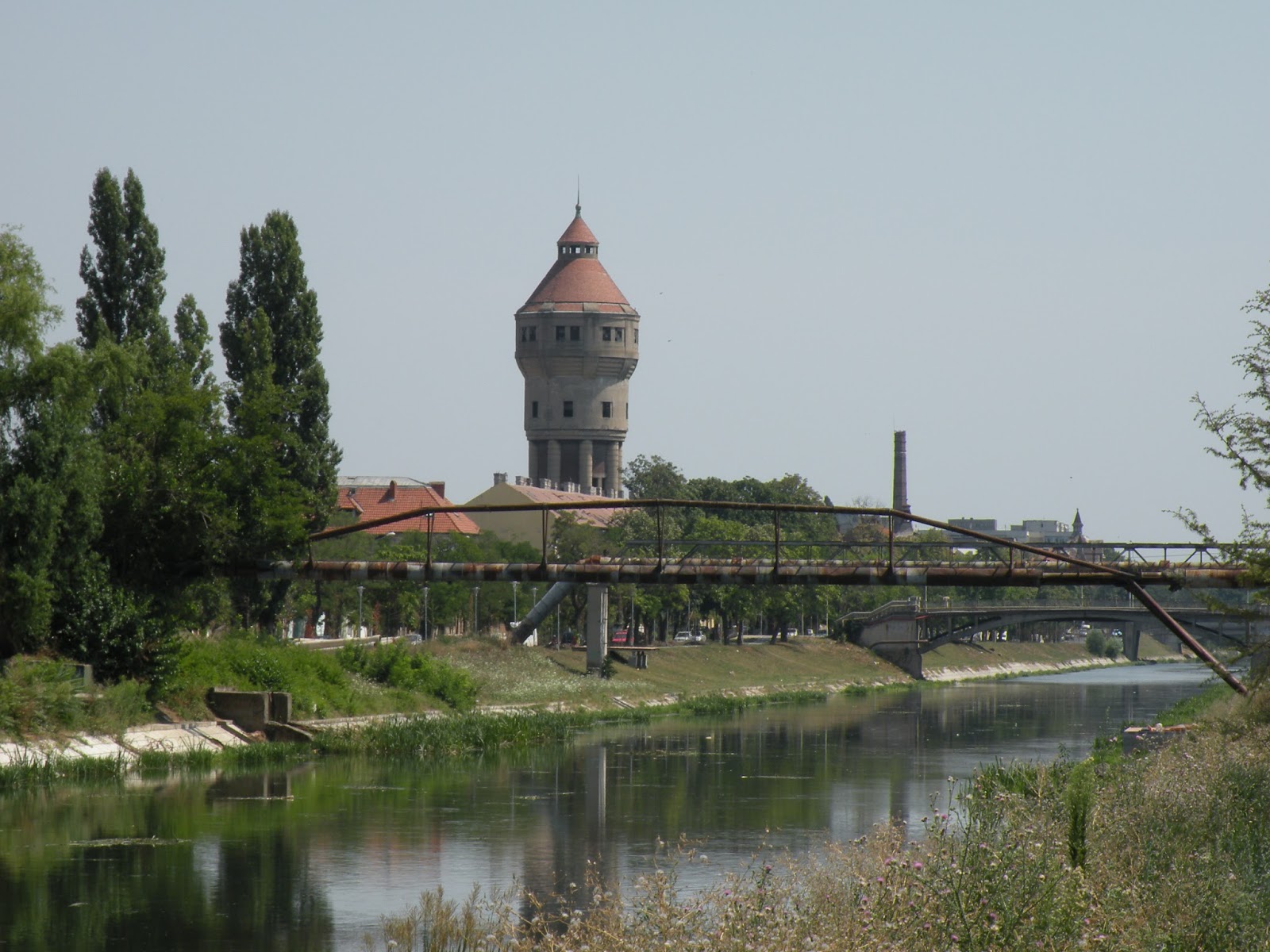
We also took some time to follow the city's tram routes. Timisoara is not very big in terms of square kilometers. It comes to an end quite sharply and the trams reach the extent of the city's limits. On one tram ride, we got off right at the edge of the built up areas when Koos spotted an impressive silo. We alighted at the ideal moment, it seemed, as we found ourselves next to the canal again, but this time with a more industrial purpose. In many respects, this was our best Timisoara experience, possibly hard for some to understand, but this is where Koos and I meet wholeheartedly. It had fabulous industrial buildings, charming side streets full of local character, and above all, the peace of a parallel watery world; something I think we both needed at this point.

Along the Bega Canal on the outskirts. 

Timisoara water tower

Plums for the picking on the canal side

Silos - industrial cathedrals

The most charming side street off the canal. I want to live here!

So that was Timisoara. It would be impossible to include everything about our stay in this blog, but I hope it gives some impressions of what a lovely, exotic and special city it is. We did what we enjoyed, a canal boat trip being an essential, and just absorbed as much as we could.
The rather debonair skipper on the boat trip

What we love: the parallel world of the water

After three days, we moved on, and that means one more post. This will be about Orastie, a surprising jewel and Alba Iulia, a disappointment with benefits, but that's for next time. I think this is quite enough for now, though, and I apologise for keeping you on my page for so long. Thank you for your patience in reading this far! Have a wonderful weekend everyone. xx


Monday, July 13, 2015

Dealing with loss

I’ve just read Jo Carroll’s very moving post about the passing away of someone she has known since childhood. She has expressed it beautifully and as I read it, I just wanted to keep saying ‘yes, yes – that’s just how it feels.’

In my last post, I touched on the fact I’d lost a very dear friend recently to cancer. It happened when I was in South Africa, something I’d been dreading since I booked my flight several months ago. Unlike Jo's, my friend was not very old, but the battle with cancer had been going on for nearly four years. In the last months, it became clear that it was a matter of time - and I knew it. Nevertheless, I  haven’t felt able to write about it for two reasons: one being that I know the family wouldn’t want anyone to put two and two together – I , like Jo, have to and want to respect their privacy and that’s increasingly difficult on the internet these days; the other is that I really could not find the words to say how I felt, except that a very important light in my life has gone out.

Jo’s post is so moving; she writes with such perception, I’d like to link to it here. Please read it.

For myself, this photo was one I took in South Africa on learning the news. I was given some time to be alone (thank you, Moira), so I wandered round these tracks taking it in - dealing with the 'dislocation' as Jo puts it. This image, with its rails disappearing into the distance, felt fitting.


Thursday, July 09, 2015

Getting back to writing

Just for some eye candy. My Zeeland view

The year to date has been full of challenges and there has been quite a bit of stress involved that has distracted me from writing. But now at last I am pleased to be getting back into it. It's not easy, though. I find I lack energy for very much and the old flow is difficult to regain. Doing my Master's took a lot out of me; I also lost my beloved dog to old age and a very, very dear friend to cancer. None of these has been easy to deal with.

But back to the writing: my current books will never achieve best seller status. I know that. The idealistic dream was just that - idealism in its most optimistic, but unrealistic form - lovely while it lasted, but that was about as long as it took to press the publish button on Kindle. The English speaking market here in NL is relatively small; there are few shops stocking English books, but there such readers as there are usually have the internet,  so native speaking readers have a huge selection to choose via the multitude of online bookstores.

The result is that I only have steady sales via Kindle books, mostly through Amazon.com, but…telling enough...I've only sold one on Amazon.nl in the last six months! Of the Kindle sales, the majority are my memoirs. My fiction doesn't do well despite winning an award for my teen novel, so I've come to accept that memoirs are the best area for me in terms of selling, but is that what I want to keep writing? And why do I write anyway?

A bit more of my view. Writing inspiration

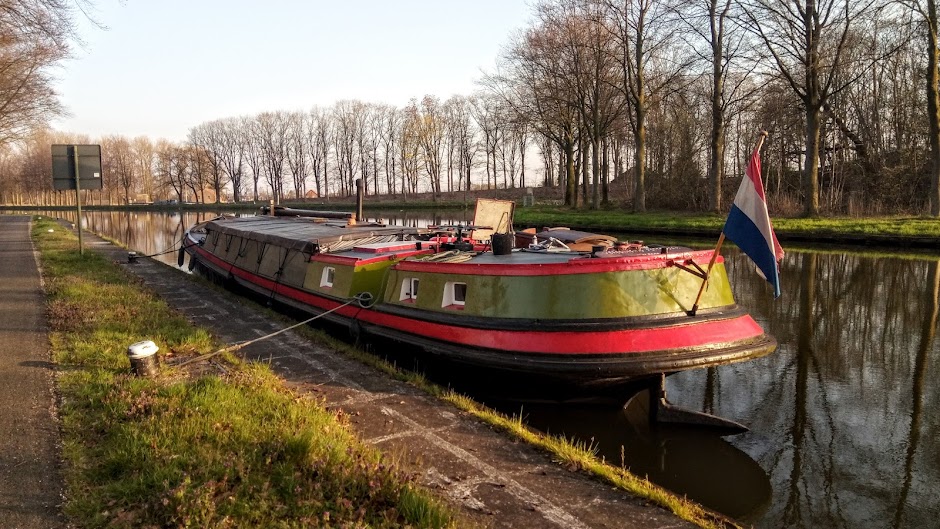
At the moment I'm busy working on the account of the three years we lived part time in Belgium. By that, I mean we were weekend residents on our barge in Brussels. It was a period rich in experiences and recollections, so I am writing about those and hoping to publish them as an e-book later this year. I've also got an African story in the pipeline. Light hearted and hopefully humorous, but nothing of great literary value.

What I really want is to write a 'real' novel and that's what I'm aiming for. I enjoy writing the non-fictional narratives, but I miss the freedom of creativity that fiction gives.

I loved writing The Skipper's Child, which was set in the 1960s, but I'd like to go back just a bit further in time and write a novel about war time on the Dutch waterways. It's going to take a lot of research and I've been buying books about the period, all of which are in Dutch - quite a challenge for me still. My plan is that this one will be for adults, and not a YA book. It will also be part thriller, part history, part family life and relationships. Again, Koos' father has been something of an inspiration. I never knew him, but I feel he was a courageous man of great principle and he would not have baulked at doing what he knew to be right. I'm really excited about the idea of this writing project, but I know I've got to do the reading first, so….

For the next year, I'll be finishing my Belgian memoir and the story set in South Africa (which I confess I started months ago). These two are easy to write. They will be my outlet until I'm ready for the big one. I just have to keep at it and get my writing flow back again!

In the interim, I'm busy with boats (as always), gardens (I prefer to look, but they don't do themselves) and travelling (a trip to Romania coming up), so life is pretty full despite my apathy. Maybe it's not that bad, hey?

My favorite plants of all time - Hollyhocks
known as Stokrozen here
Have a wonderful sunny weekend everyone…(okay, I know I'm starting early, but that makes a change) xxx

Wednesday, July 01, 2015

Absence makes the heart grow fonder…or South Africa in ten days

The title of this blog has more than one significance for me. For one thing, I've been away from my blog and blogland too long (why is life so busy?). For another, I've been away to a country and a friend I've missed sorely over the years and in that sense, I have probably grown even fonder of it than before.

For those I haven't seen on Facebook, I've just spent ten days in my beloved South Africa with my dearest and best friend, Moira (I wrote about our friendship back in 2007 here). It seems almost daft to talk about 'best friends' at my age, but Moi is one of those for whom time apart makes no difference. Within seconds of my arrival, we were giggling over absurdities just as we've always done.


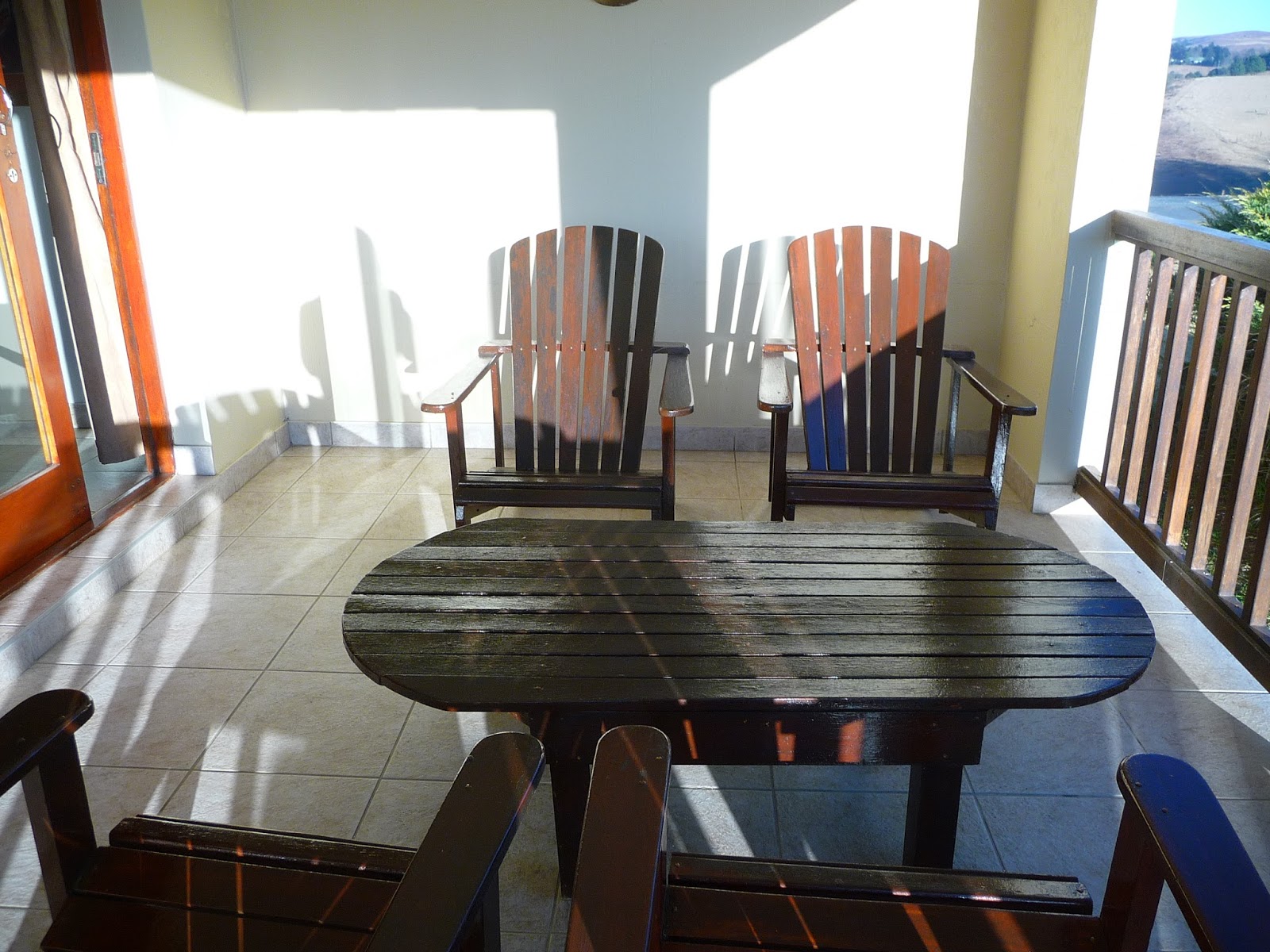
We drove from Johannesburg to the midlands of Kwazulu Natal, a hauntingly beautiful part of the country, where we stayed in a self-catering 'chalet' (although what it had to do with quaint wooden houses and decks remained a mystery to me as in reality it was a full-sized house). Every morning of our stay, we got up, wrapped blankets around us and went onto the veranda overlooking the magnificent foothills of the Drakensberg. The early part of each day was chilly, but the sun shone in cloudless blue skies as we sat there talking, laughing and drinking coffee (or tea in Moi's case) accompanied from day one by the stable cat. She in fact moved in and never left, so Moi took her home to Jo'burg at the end of our stay with the blessing of the stables' owners.

We sat here every morning wrapped in blankets

View from our veranda
We did a few trips out, and a good deal of walking, but mostly we were there to relax and catch up. I wrote a diary during the week, and reading it back, I chuckle anew over the daft things we did: trying to reach the chalet car port by driving over the garden instead of the road (a rather bumpier ride than intended) and attempting to open up the house with the car keys (it was more like forcing an entry) were just two of them. We got the giggles like school girls, and one evening we were laughing so much over my cavalier attitude to cooking dinner, I had to dash to the loo before I had an embarrassing accident. 

We had some lovely walks. This retreat was on one route

A trip out to Giants Castle in the Drakensberg

Giants Castle reserve

The mighty Drakensberg

Trains - always a draw card for me
But then there were the incredible stars - the Milky Way seemed so close you felt could touch it, and the Southern Cross was like a vivid beacon, a true guiding light in the sky.  There were the fire-breaks and controlled burn-offs (plus some that were uncontrolled and scary) that I remember from living there myself. And there was the beauty of the scenery to make us stop in awe. Even more impressive was the Mandela Monument near Howick to remind us of what the country has been through. There were also the observations I made: for instance, people are so very open, helpful and friendly that for me, coming from this northern, more reticent culture, it was a wonderful reminder of SA's great (and justified) reputation for hospitality. Another observation was how things have changed to meet the new market demands there. I was highly entertained to notice that the clothes mannequins in the shop windows all had very pert, well rounded behinds - no longer the skinny European style models! As I said, local market demands…

An out of control burn off - scary!

The amazing sculpture of Mandela by Marco Cianfanelli

Lions River. This old house now houses
a sort of antique shop

Lastly there was the clear indication that while the affluence in SA is now much more evenly spread in terms of racial mix, there is sadly no real diminution of the numbers of desperately poor people. Many of these have come from neighboring countries - from economies crippled by conflict, drought and mismanagement - and are seeking a better life. Nevertheless, South Africa is not yet economically strong enough to cope and the pressure on its own infra-structures is showing. Power cuts are a regular occurrence with scheduled 'outages' of several hours several times a month. More and more, people are talking about 'going off the grid' and making their own electricity with solar power. 

To add to the problems, a failure in water management planning means that in some places 50% of the drinking water is lost 'in the pipeline' due to lack of maintenance and even theft. This, in a country prone to drought as well. These are challenges South Africa is facing. They are serious, and they will need to be addressed if the people are to move forward.

Water is often wasted in the (broken) pipelines
All said, though, and despite these issues that I discussed at length with Moi, it was a fabulous ten days and it did me a power of good to spend time with my Best Friend. I don't honestly know when I'll be able to go back again; there's no doubt I always leave a part of my heart there, so I'm sure it won't be too far off as I can never stay away for long.