Showing posts with label Ittre. Show all posts

Monday, August 27, 2018

The not quite final leg

Leaving Ronquières suddenly made me realise we really were on our way home, so my mood was already prepared for nostalgia as we approached Ittre and the stretch of this canal that we'd spent so much time walking and exploring when we had the Ténacité in Brussels. It is also worth noting that Ittre lock is the second deepest in Belgium (if you don't count the huge sea locks in Antwerp), only beaten by a few centimetres at Ternaaien in Limburg. It is 14 metres deep and to go down it in a boat is quite an experience. When entering at the top, it looks like any other lock on the system although the presence of floating bollards is a pretty good indicator that it is deeper than normal. But the true realisation of just how deep it is comes as a surprise when the unsuspecting boater drops further, and further, and still further. I hope these photos give some impression of how truly awe-inspiring it is.


Moving out into the wide basin below Ittre lock brought a wave of memories. We'd come here so often just to walk in this lovely valley, and at one time, we'd planned and even been given permission to bring the Ténacité here. Somewhere on the quay, there may still be the bollards we put in for mooring. We dug the holes and surrounded the bollards with concrete to create a basis strong enough to withstand the pull of the commercials entering and leaving the lock. It was a heap of work. As things happened, we never used them. I sold the Ténacité before we could move there, but the memory of those dreams lives on.

From Ittre, we continued through Clabecq, another spot where we'd spent happy times on the Ténacité, before crossing the language border into Flanders and going down the 7,7 metre Lembeek lock; not nearly as dramatic as Ittre, but still pretty deep. From here on the countryside reflects the cultural difference between Wallonia and Flanders in a special way. Where in Wallonia, verges are deliberately left undisturbed to allow wild flowers and grasses to flourish, in Flanders, they are neatly trimmed and orderly. Both have their own beauty, but the difference is more than a little clear. 

What we hadn't remembered, though, is that it was quinze Août, the 15th of August, and regardless of whether you are in Wallonia or Flanders, everything (and I mean everything) is closed for this very Catholic public holiday celebrating the ascension of the Blessed Virgin. I know it, but always forget as it's not a Dutch holiday; nor is it an English or South African one, so it just doesn't sink in. We stopped in Halle to do some shopping, only to find the supermarket firmly shut, so we continued on to the next village of Lot, where we found a perfect spot to spend the night. It was below the lock and next to some handy picnic tables. Luckily for us, Lot boasted a night shop run by an Asian gentleman who was surely not aware of the holy Mary's ascension to the heavens and for a price, was happy to sell us a few necessaries.


During our walk through the village, we saw a white ringed dove with a nasty wound on its back. It looked as if it had been attacked, perhaps by a hawk or other bird of prey. The poor thing was standing in a doorway and seemed to be seeking a safe shelter. Worried about its fate, we asked the shopkeeper for a box so we could pick it up on our way back. He kindly gave us one, but when we retraced our steps, the bird had gone. I could only hope someone else rescued it and took it home with them.; it was such a pretty creature and it looked so vulnerable.

We enjoyed our evening in Lot very much. Although we knew the place from earlier visits, we'd never stayed there overnight, so in that sense it was new for us. In the morning, we spent some time cleaning the Hennie H before setting off again; our old lady needed a bit of a smoosh up before presenting her to Brussels.

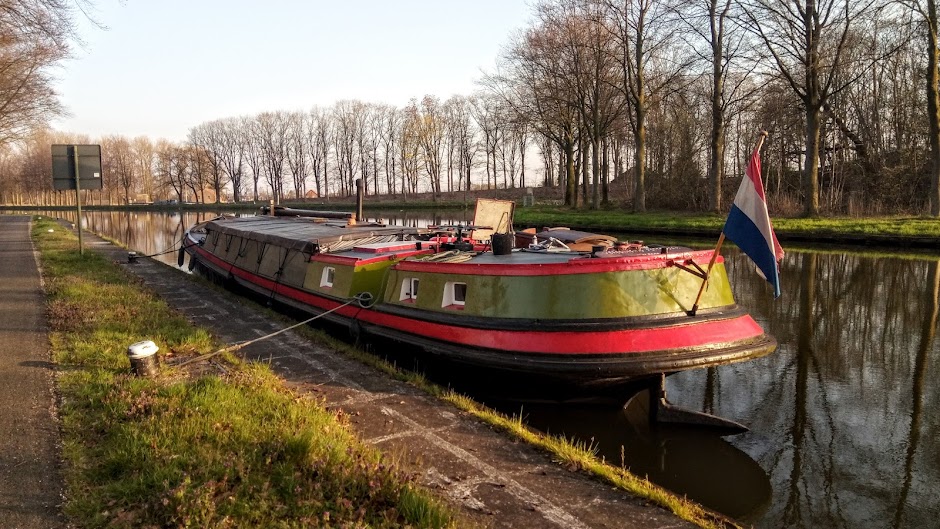
As we neared the city, the memories crowded in. It was all so familiar and I could almost see my younger self walking along the towpath with Sindy, encouraging her into the water at her favourite spots. And then we were there, motoring through the gutter, under the bridge and into the basin where the row of barges lay that still included the Ténacité. Many of the boats seemed neglected and unloved, but times change and people have less energy for maintenance as they get older. It was particularly sad for me to see how much in need of some TLC my old girl looked.

The row of barges that was once our home
In many ways, getting through Brussels was a relief. Once past Molenbeek, it was all new watery territory for me, and I enjoyed the increase of commercial quays and docks. It was good to be out of the city area. The canal remains wide; it is lined with trees in many parts and interspersed with both commercial and residential areas to keep it interesting. Eventually, we stopped for the night on an old quay on what seemed to be the outskirts of Grimbergen, just beyond the bridge in the photo below.

Typical canal lifting bridge

Being such a warm evening, we decided to look for a café to have a beer. Grimbergen is a well known Belgian brew so we were convinced there'd be a hostelry on every corner, but we were much mistaken, not only about the cafés, but about it being Grimbergen too. There was a church and some houses around it although the road was dug up making it largely inaccessible; not that we'd have found anything there. In fact, the real town was some distance away and all we found was the local ladies' football club where they had a bar and welcomed us in with good cheer. 

Commercial quays outside Brussles


We sat outside, chatting to one of the mums and watching a team of teenage girls at practice. Different, but probably more convivial than propping up the counter in a pub. Mum told us that at one time there'd been several cafés round the church, but that was about forty years ago. Dutch by birth, nationality and accent, Mum told us to our surprise she'd grown up in the Grimbergen area. She sounded totally Dutch – until she spoke to another local, that is. Then she was all Belgian. We had a lot of fun being part of the local scene, albeit it very briefly and it is encounters such as these that make travelling so full of rich memories, isn't it?

Another typical Brussels canal bridge
Well, it seems I still haven't reached the end of the journey and I'd better stop here before this blog goes on forever more. I'm so sorry I take so long to get to the point; it's just that there's always so much to tell and I have to cram it all in. Next time, I'll get you all back to Gent with me, but for now, have a great week allemaal.

Monday, August 20, 2018

Revisiting familiar waters

Our return journey back down the Sambre last week was made with much regret. We'd have loved to go on, but knew we had to return to the Netherlands. Still, our route, which happened to be the quickest way home, was one we hadn't yet done on the Hennie H even though it was through country and waterways we were both very familiar with.

While still on the Sambre, we spent some time exploring a bras mort of the river (dead arm), which was a victim of its canalisation (they tend to chop off the curves when they can). It is now a nature reserve and made a restful walk during our brief stop. We needed lots of rests, of course...this is such a stressful lifestyle.

A dead arm of the Sambre

Tourist information about the arm

A peaceful rest stop


Our first night of the return journey was at Boussières (of the free 'source' water), where we'd been on the way up. As we were tying up, two friendly faces appeared and we realised with surprise it was Dominique and Rachelle, a lovely couple we'd also first met in Thuin. They'd arrived on a very pretty small Dutch barge and we'd had great fun chatting to them, so it was with genuine warmth and pleasure that we invited them on board for a glass of wine. Their home port was Hautmont, just a few kilometres downstream and they were out for a bike ride along the towpath when they saw us mooring up. Meeting fellow boaters as we do, wherever they come from, is such a pleasure and these two will be remembered with great fondness as well. They spent about an hour with us before taking off on their bicycles again. We all parted with smiles and ours lingered for a long time after they left.

Boussières sur Sambre, one of our favourite moorings this trip

The following morning, we set off again but made a quick stop in Hautmont to go to the shops. I needed to stock up on my favourite plonk, the absurdly cheap Aude red wine that only seems to be available at the Carrefour there. At €1.50 a bottle, you can tell how good and exclusive my taste is...

As we'd already spent a night in Erquellines (the last/first town in Belgium depending on your direction) on the way, we decided to make our next stop Jeumont, (the last/first town in France) and only place to stay after we'd returned our télécommande at the final lock. We'd been warned that we shouldn't leave the boat unattended there, but when we reached the halte nautique, we found it a clean peaceful mooring with free electricity and water. It was also next to a kind of pod tree (my name) which provided wonderful shade from the now revived heat.

Contrary to expectations, Jeumont became memorable for two events that had nothing to do with the mooring. The first was the worrying sight and sounds of parents and police looking for a six year old girl that evening. She'd gone missing and the anxious calls and search lights in the water had us concerned for her safety too. However, since everything went quiet around 11p.m., we hoped it meant they'd found her and the search was over. The other was our meeting the following morning with a young couple who invited us into their home so we could take a photo of the ruined chateau from their bedroom window. Not only this, but they also took us on a walking tour of Jeumont's special attractions: a rescue animal sanctuary and a magnificent lake formed from the Wattisart quarry flooded by the Germans in WW1. Stephanie and Bruno's open warmth and generous hospitality were among the most remarkable highlights of the journey. We were amazed, jaw-droppingly so, that they would welcome two total strangers into their home and then disrupt their own plans by giving us a guided tour of their town.

Jeumont

Chateau ruins at Jeumont from our hosts' bedroom

Animal rescue at its best

The flooded quarry of Wattisart

After Jeumont, we meandered our way back along the now familiar Belgian section of the Sambre, enjoying its beauty again and noting how the waterside villages in Belgium are so much more visible than they they are in France. How charming they are too with their mismatched houses and narrow winding lanes criss-crossing the hillsides. We have decided we need to visit Solre-sur-Sambre by car as it's the only one we haven't been to yet. Our last night on this non-commercial upper river was at Lobbes. At first sight, it isn't as attractive as some of the other villages, other than the magnificent collegiate church at the top, but when I took a walk up the hill that evening, I found the village around the church. It was too lovely; a haven of peace, quiet streets and pretty cottage homes. The church itself has a long history, which you can read about here, and is apparently, the oldest of its kind in Belgium. It seems this whole area can boast a number of firsts, oldests, bests etc, but that could also have something to do with local pride... maybe?

Cobbled streets up to the church


The collegiate church of Saint Ursmer

Evening in Lobbes
Steps to cope with the steepest ascent (or descent) from the
upper village

Our final night on the river was back at Marchienne au Pont, where we'd started. Again, although a run down area, we enjoyed the mooring in the evening sunshine after a day of heavy rain and spent a very peaceful night there along with two other pleasure craft: one a small, immaculate Belgian cruiser, whose 'skipperess' came to help us with our ropes when we arrived (always nice) and the other, a large and very luxurious modern Dutch barge that would have challenged the Hilton Hotel for swish fittings.

The following morning, I passed the cruiser on my way to the shop and noticed the couple on board were playing Scrabble. I wish I'd thought to get a couple of board games like that too, but when I think we both took guitars to play and barely touched them, I wonder if we would have played board games either...something to consider next year, perhaps. At the shop, I practised my French again and was rewarded with an encouraging compliment by the woman serving me. One of the best aspects of being in France and Wallonia is how supportive the locals are when you try and speak French. I know my grammar and vocabulary are lousy, but they really help me to keep struggling on and seem to understand my mangling of their beautiful language.

From Marchienne, we ploughed on and reached Ronquiéres on Tuesday evening. I had expressed a wish to spend the night at the top of the great inclined plane just as we'd done 15 years ago when we first brought our old barge, Ténacité (Volharding in Dutch), back from the shipyard on the lower Sambre. This time, the evening was glorious and I was overwhelmed by the peace, as well as the memories the canal was evoking. The evening light was glorious and a whole team of swallows swooped and played aerobatics for us over the water, a prelude to two days of treading old paths and re-living special recollections.

My old barge, Ténacité 

Approaching Ronquières

Moored on the aqueduct
We walked along to the towers where the caissons arrive and watched a boat coming up and then another descending. The whole process takes about 25 minutes and I was looking forward to doing the same descent the next day. The last time, it had been wet and cold (an event I describe in my memoir, Walloon Ways), so I was hoping to be able to see more this time.

It was fantastic. It really was. Despite being cloudy and cool, we were both able to spend the whole descent on the walk way and take photos and film it as we went, so  I hope I can publish that sometime soon. Being able to watch every metre, hear every squeal of the turning wheels and feel every clonk of the caisson's progress over the rails was in many ways more impressive even than the big lift at Strépy. What a way to descend the nearly 68 metres of this canal. And then there was still Ittre to come.

In the caisson at the top of the Inclined Plane

Almost at the bottom. Our big bath (caisson) has trundled all the way down
that hill!

Update: And here's a video put together by Koos:
Our boat Hennie-H in Ronquières from koos fernhout on Vimeo.

But....I think I'd better stop here and write about the rest of the journey next time, or this post will be far too long (again). I hope you've enjoyed the ride so far, and I promise the next post will the the last! Have a great week, allemaal!