Tuesday, March 24, 2026

The meaning of de-greening

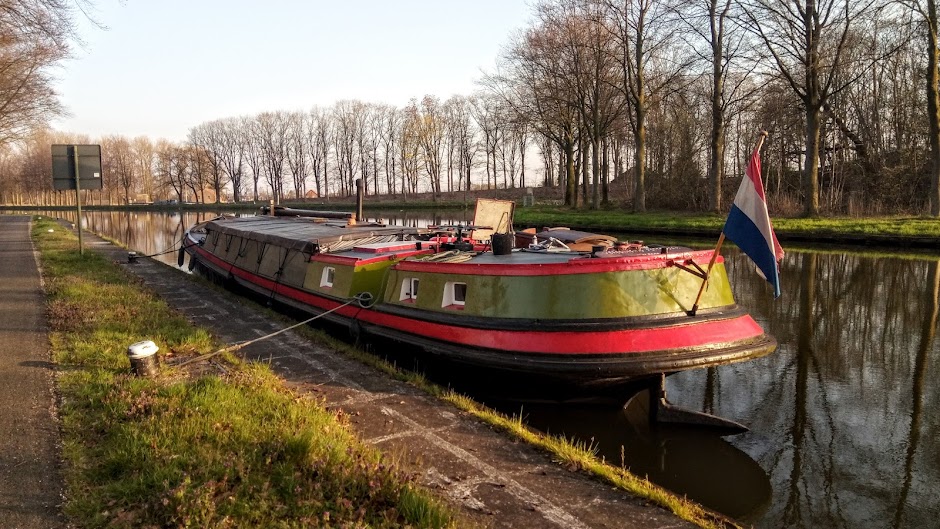
It's that time of year again, oh readers. Time to get on board and do something about the ravages of winter on my poor Vereeniging. To give you some context, the harbour where my barge is currently moored is on the big shipping canal from Gent to Terneuzen, where the massive North Sea Port locks lead the huge cargo ships out onto the Westerschelde and from there either east to Antwerp or west to the Channel. The canal is wide and open; it is also a wind tunnel. We have a surfeit of wind in Zeeland as it is, but when it is funnelled along the canal, what might be a mere breeze on land gathers the strength and force of a gale on this bottle-neck of a waterway.

The result is that it abrades my paint work with as much power as a sandblaster and all the good work we have done the previous summer is stripped away. Add to that the mould and moss that accumulate due to the clinging damp of a Dutch winter, and there is some spring cleaning to be done as soon as the weather permits.

I've written about the not-so-joys of de-greening my barge before, both in my blogs and books, but this year it has, so far, been more enjoyable. Over the last week, we've been blessed with some bright and sunny days. While I wouldn't go so far as to say it's been warm, Sunday was an exception and the temperature climbed to around 15ºC in the shade. In the sun, it felt quite a bit warmer, so daughter 2, aka, Jodie, my 2IC when it comes to all matters Vereeniging, opted to climb into our tiny boat and de-green the wooden rubbing rail. Armed with a bucket of cleaning vinegar and an old washing up brush, she happily scrubbed away at all the parts I could not reach from the deck. I employed a second old brush and container full of vinegar to work from the foredeck. Zoe supervised from the top step where she loves sitting when I'm working outside.


I think I can genuinely say a pretty good time was had by all, and Jodie particularly enjoyed the impromptu spuddle she took when changing sides. 


And so, repeat. A further rondvaart (round trip) ensued when she followed up the de-greening by oiling the wood, which helps to protect it.  Of course, all these photos cannot hide how much work needs doing on deck and on the woodwork of the rear entrance.


But we have also managed to sand and revarnish the mast. I gave it another coat after I took the photo below as the birds (which I've also written about in my stories) have yet again been using my barge as their favourite latrine. I swear they perch on the mast in a row and go 'ready, steady, poop!' in unison.


Still, once we'd finished those tasks, the temperature was dropping and we opted to stop for the day. Luckily, it is only the end of March and as long as April gives us some more of the same, we should be ahead of the painting game this year. 

And so it was time for me to have a spuddle too. Koos had come to see how we were doing, so he caught us in the act. Our little boat is a tad small for two people, but we managed and enjoyed our jolly up to the end of the next boat and back. A perfect way to end the day!


Wishing you a good week allemaal. The world might be in a very uncertain and precarious place at the moment, but when the sun shines and there is even the smallest boat available, life can still bring a smile to our faces. As Mole so rightly said in Wind in the Willows, "there is nothing — absolutely nothing — half so much worth doing as simply messing about in boats".


Saturday, March 14, 2026

A different kind of driving test

 I don’t remember exactly when it was now, but back in the early noughties, I took myself off to the UK to follow a boat handling course which also involved taking a short theory test on the CEVNI (Code Européen des Voies de la Navigation Intérieure or European Inland Waterway rulesto qualify me for the RYA (Royal Yacht Association) inland waterways’ helmsman’s certificate, valid in Europe as well. I did the course on a narrowboat on the Thames, then I took the theory test. It involved maybe a dozen questions on the rules, but that was it. I passed both, but I somehow never felt I was really qualified for navigating Europe’s waterways. I just had that feeling something important was missing.

For a start, driving a narrowboat on the Thames, upstream of the tidal stretch, in fine weather, didn’t seem like sufficient preparation for driving my Dutch barge with a wheel, not a tiller, on a very busy commercial and tidal river in windy, often bad weather in the Netherlands. The two just didn’t relate. Secondly, the theory test seemed skimpy to say the least. Since then, and because of my lack of confidence  in the training I received (not their fault at all – the situation was just too different), I have generally left all the steering and manoeuvring to Koos. He was born on a barge and to him it is as intuitive as breathing. It wasn’t difficult to accept that his skill would always be greater in all and any situation.

However, and this is the thing, I stupidly let my English RYA license lapse, and it’s now too late to renew it. As a result, and because I can’t always guarantee Koos will be available to be my skipper when necessary (of course, he’s always willing, but you never know), I decided to study for the Dutch waterways’ permit, known here as the Klein Vaarbewijs (certificate for operators of pleasure craft). There are two parts to this license and I’m aiming to do Part 1 only as I have no intention of cruising on wide waters where there might be waves. Big ones. I do not do the sea or its equivalent. I get hopelessly sea sick and that would never do if I were taking on skipper’s duties, so Part 2 is one I deem to be unnecessary for me. It also means no one can ever ask me to cross the Westerschelde estuary, my big horror. Smart, eh?

Anyway, I’ve been at it now for a few months and I am staggered by the amount I need to learn. It is so much more involved than the somewhat meagre CEVNI rules test I did, which amounted to knowing what a few lights, boards and symbols meant. Now, I need to understand the theory of manoeuvring with both a right and left turning propellor, what effect a bow thruster has (which we don’t have) and what the right of way rules are for sailing boats, both in relation to other sailboats and to motorboats. There is also technical stuff to understand about diesel, petrol and electric engines, both inboard and outboard, as well as regulations for the Dutch waterways and those rivers that are part of the Rhine system. The BPR (the Dutch rules) are often different from the RPR (the Rhine rules) as regards who has right of way in different situations.

I have to say my brain is spinning with all the different information I am having to retain and I’ll be very happy if I just scrape through the exam. I’ve booked it now so for the next few weeks, I’ll be practising during the countdown. Wish me luck and some nice easy questions! 😄

In other news, spring sprung and then slumped back into winter mode again. So far, March has been cold, wet and none too encouraging, but my forsythia is doing a great job of blooming with enthusiasm and we are getting one or two jobs done on board when conditions allow.

Here are a few photos to give you the idea that the world is waking up.

A sunny afternoon today

Our village

Commercial barge on our canal

My beautiful ship

Typical March. Undecided. Should it rain or 
shine?

Have a lovely weekend allemaal and I wish you all a peaceful, pleasant week. The world might be about to implode, but as long as the sun rises every day, we can have hope.

Friday, March 06, 2026

Pretty as all the pictures

We’ve been back from France a few days now and in that time, the spring has sprung, the waters have subsided and March is set to be as dry as February was wet. In the space of the week we were in the Haute-Marne, huge lakes reverted to fields and the waters of the Marne ceased their torrential rage and dropped a good 60 cm. It was glorious to see the sun shining, so Koos and I enjoyed seeing the villages come alive again. People started working on their gardens, sweeping away the debris left by the rain and storms and generally tidying up their world. I also noticed lots of activity with wood chopping, sawing and stacking. It seems our village folk are already preparing for next winter. Maybe we should take note!

The photos below are just snaps of some of the lovely days we had in the area. These blue skies did much for everyone’s spirits.


In my last post, I showed you a couple of photos of our local laverie at the beginning of the week. It was completely submerged in water then, and the river was lapping through the door. By Sunday, we could go into it and the water had dropped below the second step, which was incredible to see. It’s awe inspiring how fast these changes can occur.


The river was around the roots of these bushes the previous week. By the time we left, it was almost back to normal winter levels.


And the tree lodged against the bridge here was almost completely submerged when we first came to look at the waters. It’s  now exposed and will have to be cleared away, or it will become a dam which could cause flooding too.


And now we are back in our other lovely place where horizons and watery vistas take on their own special significance. This ethereal scene was at the creek a few hundred metres from our Crumbly Cottage early one morning before the sun had burnt through the low lying mist.


And here is a scene from my walk with Zoe this morning. Our village runs along a dyke so we can be out in the fields in no time. Here, I’m looking back to an old brewery, one of at least four that used to operate in this community. No wonder the Belgians like it! 😆 In fact, there are no breweries and no tramlines along the dyke these days, but the village really is very popular with our neighbours across the border. The population has a high percentage of Flemish folk and it’s nice to feel part of their culture too.


 Have a great weekend, allemaal. We will be busy with boats, I think, so watch this space for news on cleaning and degreening!