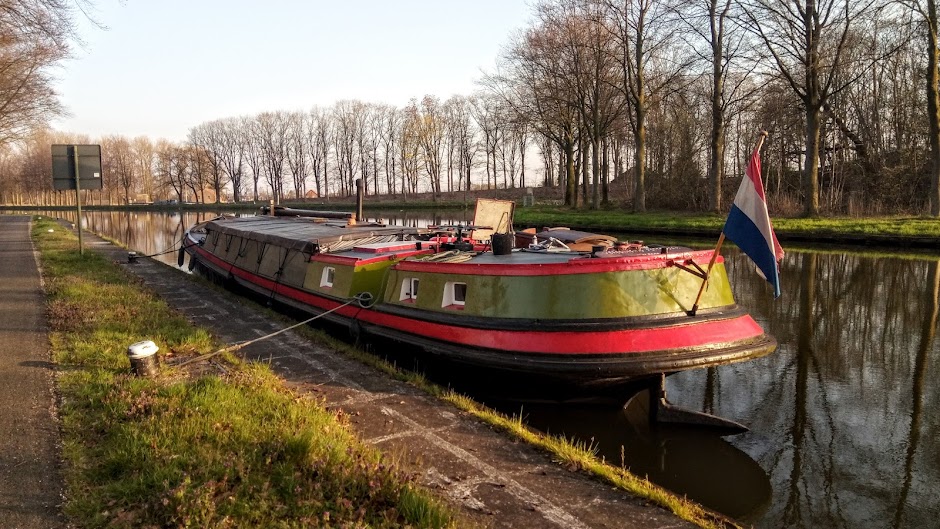
Before I go further, I just want to say that this post is not intended to be pedantic, nit-picking or difficult; it's just to make things a little clearer for my international readers.
To give you some background, I have a number of friends and contacts on Facebook, X and Bluesky who are genuinely interested in my life with boats, and barges in particular. I really love the way they follow my posts, send me photos of canal boats and even fascinating articles about life on the water. I can't tell you how touched I feel and how much I appreciate their enthusiasm for my watery life by sending them to me or tagging me in what they have found online.
One thing I've noticed, though, is that quite a lot (of course, not all) of my friends refer to my barge as a narrowboat. I don't mind for myself but the point is that (and it was a surprise to me too) a narrowboat is not a barge. However, my Vereeniging is a barge; she's a Dutch barge to be more precise, and she was built for carrying cargo, and even animals, along the Dutch canals. She is 3.2m (10.5 ft) wide and is nearly 20m long (about 65.5 ft). QED, she is not a narrowboat.
So what does that mean? What is a narrowboat? And why can Vereeniging not be called one? Well, a narrowboat is uniquely British for a start and it is, as its name implies, very narrow. Anything with a width (or beam) of more than 2.08 m or 6ft 10 inches is not a narrowboat. In the past, they used to carry cargo and were called 'narrow boats' as two separate words, but all modern narrowboats (one word) are purpose-built to be pleasure craft or liveaboard boats. There are a few historic narrow boats left and they still cruise the British waterways, often carrying cargo such as coal, wood and fuel for other boats. They are beautiful; they are revered and they are very special, but they are still not barges. What's more Dutch barges can never be called narrowboats, however much Vereeniging might remind people of them.
Have a look at the comparison photos below and maybe you will see the difference more easily. The first three are my photos of Wandering Snail, a narrowboat that belongs to dear friends of ours, Anne and Oll, who cruised Europe's waterways for several years.
 |
| See how narrow Wandering Snail is? |
 |
| Narrowboats have no real foredeck. They have a 'well', which is a cosy place to sit when you're travelling. |
 |
| And this is the lovely Snail on the water. Note the high sides with portholes and the decorative paintwork. |
 |
| And this is my Dutch barge, Vereeniging. See how much wider she is and how large her foredeck is. |
 |
| And here, you see her full length with the long foredeck for carrying either goods or animals. |
 |
| And here she is on the water. Although her hold is higher than usual, it is not as high in proportion to the hull as a narrowboat's living space is. |
The one feature both Vereeniging and Wandering Snail have in common is that they have no side decks and I often think that might be the cause of the confusion. I will admit that when I first saw my barge I was reminded of a narrowboat, and that was part of her appeal. To me, she has the same charm and beauty, but I would never dream of painting her with the traditional English canal art. Why not? Well, she's a Dutch barge, isn't she? A 128-year-old former working barge. She isn't, and never will be, a narrowboat, much as I love them.

Goodness Snail looks pristine there! She's several years older now but still loved and lived on, rather like Vereeningen!xxx
ReplyDeleteAw, Anne, she looked magnificent then and I'm sure she still does. That photo was in Ieper before we even met you (even though we were trying), so it must have been about 2007 or 2008, so yes, nearly twenty years ago!
Delete