Monday, September 23, 2024

Ieper and in between Part 3

My apologies for the delay again. I can barely believe it's over a month ago now that we were on the boat in Belgium. In my last post, we'd reached Roesbrugge on the upper IJzer, a small town, but one of some significance as it lies close to the border with France and has a long history dating back to the 13th century. What brings the town to the news more often, however, is the flooding that occurs now and then and for which the upper IJzer as a whole is known.

The beautiful IJzer

For us, it will remain imprinted in our memories for two reasons: the first being the heat – it was the day the temperatures soared to 35C – and the second was the smell. 

Having taken shelter next to the pontoon under the bridge, we sat out the sweltering afternoon to the accompaniment of a somewhat unpleasant pong. At first we thought we'd caused it by stirring up the mud in our efforts to turn around a little way upstream (see previous post) but that wasn't the case. 

Looking upstream to France from whence
said pong came

We hadn't been settled for very long when a young man from the environment authority came to assess the situation.

"There's been a lot of rain," he said, "and the sewers over the border in France have overflowed into the river. That's why it smells so bad." 

Koos and I looked at each other and grimaced. We decided very quickly we weren't going to use the river water for anything, not even cleaning the decks, and I definitely didn't want Zoe drinking it. Even so, during the afternoon, some teenage girls came with paddle boards and dressed in only the skimpiest bikinis, started floating around in the water. Koos, of course, didn't mind seeing this kind of eye candy, but I shuddered to think what they were dangling their legs in.

Anyway a short time later, we also had a visit from the fire brigade in an inflatable boat. They were coming to take samples of the water. Cheerful and friendly, they confirmed the problem with the overflowing sewers in France and mentioned it happened in Roesbrugge too in times of heavy rainfall. In any event, it seemed the solution was to oxygenate the water and an hour or so later, they installed a pump and hosepipe on the bank about a hundred metres from our mooring to aerate the water. It was still busy the following day when we headed back the way we'd come although I can't say the smell had diminished all that much.

Some interesting 'art' alongside the river at
Roesbrugge

We spent a pleasant evening nonetheless and enjoyed walking along the footpath next to the river. Another pair of youngsters came to the pontoon to inflate their canoe and set off for an evening on the water. They told us they were heading for Diksmuide but when I looked surprised that they'd be going so far, they sheepishly admitted they probably wouldn't get anywhere close before turning back. Diksmuide is a good 25 km from Roesbrugge by water. When they were fully pumped – so to speak – we wished them good speed and waved them off, hoping they'd get as far as they wanted before the beers they'd taken slowed them down. After they'd gone, the evening cooled to a balmy softness and we ate on deck while the interior of the Hennie H was cooling down. Despite the heat of the day, the night air was delicious and we slept exceptionally well that night.

When we set off in the morning, we did so just after a large group of school children in kayaks who'd arrived en masse and started loading their craft into the (still sniffy) water. While we were preparing to leave, we saw them disappearing around the bend so we lingered a little fearing to catch up with them too quickly and disrupt their canoeing. We needn't have worried. We'd travelled several kilometres before we reached them, but they were thankfully all well trained and tucked themselves into the bank to let us pass. It struck me then what a great activity it was for the kids. Being out on the river in kayaks, enjoying nature, the (even sniffy) water and the scenery seemed so healthy. 

With cooler weather and no stops, we were back at Fintele within two hours. The French couple who'd helped us so kindly the day before were still on the moorings and we waved to them in passing. Beyond the turning into the lock, the river became suddenly more disciplined and continued so all the way to the turning to Ieper. The rural wilderness gave way to more organised banks and farms that lacked the sense of adventure we'd found on the upper IJzer. 

Roughly 7 km from Fintele, we turned right and south into the canal to Ieper (Ypres). By this time, we were both ready for a break but it was a good 5 km (more than half an hour) before we found somewhere to stop. In the event, it was an ideal pontoon with easy access to land where we found a large green space, a car park and a restaurant. Not much, you might think, to attract us, but then Koos has a hungry camera and he found a feast of subjects in that rather plain space to feed his lens. 

Our perfect pontoon on the way to Ieper. We shared it
with locals enjoying the hot evening.

What struck me most was a sign that told us that Steenstraete, which was the name of the nearby hamlet, was where the first gas attack was made during WWI, a sobering reminder of how much the area had suffered. The sign also mentioned there'd formerly been a monument on the site but that the Germans had blown it up in 1941. What we didn't see was the monumental cross erected to replace it. That aside, it once again made me keenly aware we were in the middle of some of the most tragic history of the last century.

Koos will always find some subject for a photo

It seems improbable but I can't help thinking Zoe was affected by the vibe there too. She refused to go for walks along the towpath and I was limited to taking her up to the patch of grass at the top of the steps. Maybe she sensed something lingering in the soil. Who knows? Anyway, that evening, we did manage to persuade her across the road to go for coffee and ice cream at the Steenstraete Eetcafé and very good it was too.

In the morning, we spent some time cleaning our Shoe to prepare her for our visit to Ieper, one of the most important points on our trip. We only had about ten kilometres to go but this included two locks which had to be arranged as they were operated individually. 

On arrival, we called the lock-keeper who took a while to reply. Apparently, he was busy at the other lock and would be with us shortly. He turned out to be a very helpful and friendly gent who took our ropes to loop them over the bollards and even asked if we were ready before filling the lock. At the next lock, he repeated the process and told us just to call him when we were returning the next day. 

"He gets my vote for lock keeper of the year," I said to Koos.

He grinned. "Well, there haven't exactly been many of them, have there? And what about the ones at Fintele?"

I laughed. "Hmm, yes, they were great too, weren't they? Okay, let's say they all deserve a mention." 

The last stretch into Ieper was fairly unremarkable, which made our arrival and discovery of the town even more special. The harbour master beckoned us to a perfect spot alongside the pontoon. Okay, it was in full sun, but I'd covered all our windows with pieces of white tarpaulin I'd cut to size and they really helped against the heat. The price for the night was nearly as high as it was in Veurne, but we had electricity and water available, which counted for a lot. 

Once we'd settled, I left Zoe in Koos's care and trudged off to the Aldi with my shopping trolley. At only a kilometre from the boat, I counted that a blessing and, even better, the walk along the old, unfinished canal from Ieper to Komen was a treat. Apparently begun in 1864, it was never completed because they needed to dig a tunnel through a ridge whose (probably sandy) composition meant it kept collapsing. They even attempted to raise the canal by means of locks, but they were unsuccessful for the same reason and attempts were abandoned in 1913 before WWI broke out. It seems such a shame because it would be a terrific short cut for boats from Ieper, Diksmuide and Nieuwpoort through to Wallonia and France. The current way around is roughly 150 km from Ieper. Had the canal been completed, it would have been a quick 15 km to reach the same point on the Leie river.


During the evening, we walked to the Menin Gate to witness the Last Post celebration. I find it humbling to know it is done every evening at 8 p.m. throughout the year and, I'm sure, never ceases to be deeply moving. The haunting sound of the bugle brought tears to my eyes. For me, having recently written my book about faring to the Somme, being there felt like another way of paying my respects to all those who lost their lives, their homes and their land during that terrible war.

We walked back to the boat through the city centre and I was amazed at how grand and how beautiful Ieper was. I honestly thought I'd been to Ieper before but realised I'd only ever walked around the marina and its environs. There was so much I hadn't seen, so I took myself and Zoe for a good walk around the centre in the morning before we left so I could absorb some of its ageing beauty and Flemish elegance. Much of the centre was badly damaged during the war but has been rebuilt faithfully and it would be hard to tell now what is original and what is post war. Here are some of the photos I took of the centre.


I think I'd better stop again here and finish our trip in my next post. Luckily, I have all the photos and my journal to remind me as the detailed memories are already fading along with the long summer evenings. 

Autumn is coming to us here in Europe, so I wish all my fellow northerners a happy fall and to those in the south, enjoy the coming spring! Have a good week, allemaal.

Monday, September 09, 2024

Barging through Belgium on the Shoe: part 2

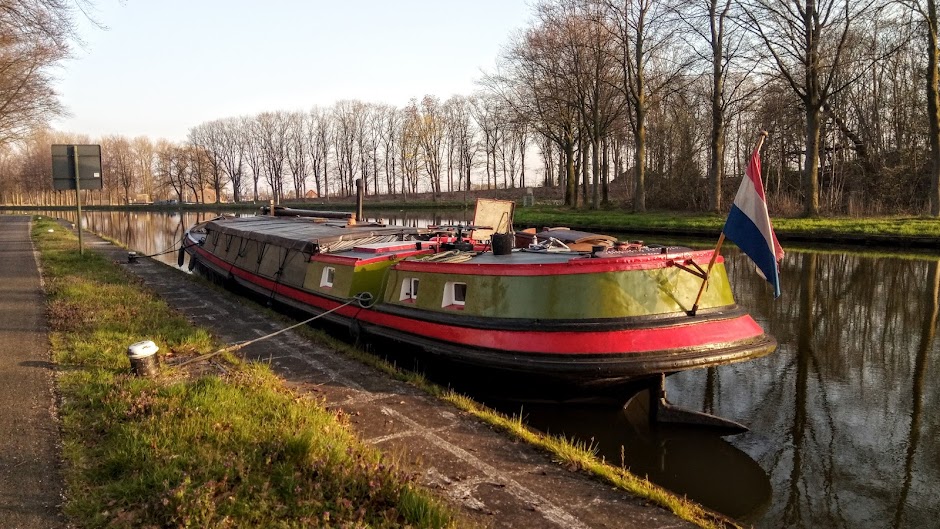
When we arrived in Veurne, we made contact with an English couple on a beautiful Dutch tjalk moored at the beginning of the pontoon where we also found our shady spot. They kindly informed us there was plenty of space and helped us locate the harbour master's office where we could pay our dues and get the electricity connected. On our last morning, they came by with their gorgeous old dog, Bilbo, and we discovered we two ladies were both members of the Facebook Women on Barges and had, in fact, 'known' each other for years. Lisa is also a fellow scribe and has written three books about their life and travels in France. You can find them on Amazon here. 

It was really lovely to chat about our common interests and I was sorry we weren't able to spend more time with them, but we had to leave before overstaying our time in the marina. We didn't manage to take a meet up 'selfie' either, but I did take a photo of their lovely barge as we fared past it on our way to the Lo Canal.

In brief, our plan was to do a loop, going south from Veurne to the village of Fintele (pronounced Fintayla) and then heading east on the IJzer river before turning south into the canal to Ieper (Ypres). After that we would reverse our steps (figuratively of course) and go north to Diksmuide. But that's not exactly how it went, as you're about to read.

Lisa and her husband's lovely barge


From Veurne, the Lo Canal extends about 14.5 km to Fintele where a lock takes the boater up into the IJzer river. For such a short distance, it was a surprisingly eventful day and involved another (not so) comedy act. 

We'd not long been through the first of the lifting bridges on the way out of Veurne when, in a moment of distraction, Koos didn't realise the Hennie H was veering to the left of the canal. Unlike me, who tends to steer the way I'm looking, Koos's attention was caught by something on the right bank so he didn't notice our progress towards inexorable disaster.

"Koos, err, keep steering," I reminded him. And then, "Koos! Watch out! There's a .... !"

Too late. 

Seconds later, we were ploughing into the low-hanging branches of a large tree for which our lovely shady umbrella was no match. Snap, it went, and collapsed. Onto me. 

I was instantly enveloped in folds of fabric while trying to hold on to its central pole, which was hanging over the railings around the stern of the boat. Oh dear. After scrambling clear of my shroud, Koos and I succeeded in pulling it in without further mishap. 

"I'm afraid it's a gonner," said Koos, staring sadly at the twisted mounting and cracked umbrella mechanism. "I might be able to fix it, but not now."

This was the third drama we'd had with umbrellas since we began faring, but it was the first time we'd lost one through an argument with a tree; quite surprising really, given the rural waterways we like exploring. It certainly gave a new dimension to our maxim 'Keep steering'. Unfortunately, that's one distinct downside of the Hennie H. We simply can't afford to get distracted, as our fickle old lady will take advantage of any loss of focus to dance off in the wrong direction.

If you see the photos below, the top one still shows the edge of the umbrella on the upper left-hand side of the picture. The next one was taken less than an hour later, when I'd already rigged up some improvised sun protection for Koos with a normal umbrella strapped to his chair on a boat hook. Our poor wrecked parasol was relegated to a recumbent position on the roof.


It wasn't long, however, before the heat was becoming just too much. The temperature was well over 30C and we were roasting on our steel decks. I'd moved Zoe into the only shady area next to the steering wheel, but that didn't help us. Koos had had enough, so when he spotted a bank of reeds in the shadow of some trees, he decided that was where we were going to rest up, come what may.

"But there's nothing to tie up to," I said, a little confused.
"Wait and see," was all I got in reply.

While I watched, Koos gathered two clumps of reeds together, wound some thin rope around them and secured the rope to the handrail on the roof of the Hennie H. On such a quiet canal, this was enough to keep us from floating away and we retreated below to have a break. Clever, eh? Reeds are pretty strong and even more so when bunched together.

Tied to the reeds on the Lo Canal between
Veurne and Fintele

An hour later, the sun had moved round and the shade had all but disappeared. It was time to move on, although not far. Within a few kilometres, we were below the lock at Fintele and moored up to the pontoon for boats waiting to go through to the river. With a maximum time limit of 24 hours, it seemed like the place for us, especially as I knew we'd soon be out of the heat and in the shade cast by the trees on the dyke. Relieved to be somewhere with easy access to land, I hopped off and took Zoe for a walk.

Fintele was evidently a popular place for day trippers, as there were three restaurants, all of which seemed to be busy. Other than that, it boasts a few houses, some good moorings for pleasure craft on the river and not much else. During the evening, Koos and I went for another walk with Zoe and met a couple who told us about the de hooipiete. 

Local farmers, they said, used to erect a wooden bridge over the IJzer river every April to give them easy access to their pastures on the opposite bank where they took their cattle and collected the hay (hooi). Come October, they would take it down again and leave the river free for the boats to pass through. This movable bridge (piete in west Flemish) was built so that sections could be removed if a boat needed passage, but when pleasure boating became so much more popular, it was decided to remove it permanently and it was last taken down in 1990. 

"The old hooipiete is over there," they told us, pointing to the long grass next to the restaurant of the same name. Sure enough, a large rectangular platform made of wooden planks was lying in the grass straddling a small ditch. Sadly, I didn't have a camera with me so I didn't take a photo, so here's an old image I found on the internet of the bridge in place over the IJzer.

Fintele (Pollinkhove): hooipiete of 'brug zonder waarborg' -
The hooipiete

Another happy discovery was that we could turn right out of the lock and follow the river upstream to (almost) the French border. On our waterways map, the upper IJzer was marked as unnavigable and we'd assumed we couldn't explore it. However, the lock keeper at Fintele assured Koos it was no problem; that the authorities had cleaned it up and we should be able to go through as far as Roesbrugge, after which the river into France is only fit for canoes. Anyway, we knew one other couple who'd (possibly) done that stretch and their boat was much shorter than ours, so we needed to be sure we could turn around and come back given that we couldn't go on into France. The reassurance from the lock keeper, added to Koos's research in finding possible turning points convinced us to go; hence our diversion from the original plan. The only remaining uncertainty was whether we could pass under the first wooden footbridge, which was apparently in need of repair and couldn’t be opened for us. We would see.

Moored to the waiting pontoon. Photo taken
in the morning from the bridge over the lock.

We left early so we could be sure of 
mooring up before the promised 35C got to us

It was eight o'clock the next morning when I took the photo above of Koos turning onto the river. I'd taken Zoe for her walk and, knowing there were moorings on the river, I'd asked him to pick me up there after he'd been through the lock. It was a glorious sunrise and the day started well with a delightful French couple helping Koos hold the Hennie H while I climbed on board with Zoe. I should mention she (Zoe) had been a little gem since leaving home, taking everything in her stride and accepting faring life without complaint or question. She genuinely seemed to enjoy all the new walks, sniffs and encounters we had, but this day would be a challenge as we knew the temperatures were going to soar.


The upper IJzer was truly lovely: rural, unspoilt, and with barely a building in sight. We went under the doubtful bridge with room to spare and from there on it was pure joy. I could well imagine the beauty of misty mornings over the land as the scenery has a kind of fenland air to it.


After more than an hour's gentle faring, we arrived at the village of Stavele (pronounce Stavuller) where moorings on both sides of the lifting bridge offered us good spots for a rest break.  Initially, we stopped on the east side (see the photos below), but we soon moved to the shady pontoon on the west. After a short walk in the village, which was in siesta mode despite being mid-morning, we retreated inside and it wasn't long before Koos and Zoe were sending up zzzzzzs in unison

Approaching Stavele

Mooring on the east side of the bridge


Before leaving, we took another walk along the towpath, which was more of a narrow track at this stage. It was interesting to find an information board describing the agricultural and market produce barges that used to frequent Stavele and also the flooding issues they experienced in the area due to the number of water courses that drain into the river there. Unfortunately, commercial barges stopped coming to the village in the 1970s (if I've managed to decipher the text correctly).


By midday, we'd completed the twelve kilometres to Roesbrugge and now it was time to find a spot to sit out the heat; we could both feel the thermometer was climbing steadily. To our huge relief, we found a long pontoon that extended below the bridge to the other side. Just perfect for us. 

"We'll just go beyond the bridge," Koos said. "The turning place I saw on Google Earth is just a little way ahead and we should be able to get round easily there”. As it happened, easy wasn't quite the word I'd have used. There was indeed an opening into the Dode IJzer (a dead arm of the river), but it was both very narrow and shallow. Added to the challenge was our little barge's left turning propellor meaning she always veers to the right in reverse. Not what we wanted at all as we needed to reverse to the left.

This is where Koos's patience is at its supreme best. Inch by inch (or in centimetres) he pushed the Hennie H's nose into the gap and reversing in tiny steps, he succeeded in doing a one-hundred-and-plenty-point turn to get us facing back downstream. My job was to shout warnings about mud, logs and the other debris we churned up in the process. A good twenty minutes later, we were tied up to the pontoon under the bridge where we were at least mostly in the shade, but also with a prevailing pong that we thought was the result of our dredging activities. 


Luckily for us, this was not the case, and our guilty feelings were assuaged. But I'll continue with the story in the next episode, when I'll hopefully get us a bit further and be able to tell you about our visit to Ieper and Diksmuide.

Have a lovely week allemaal, and I hope you enjoy the changing seasons wherever you are.

Monday, September 02, 2024

Barging through Belgium on the Shoe: part 1


Well, we finally did it. We went faring on our Hennie H for just over three weeks last month, which explains my absence from Blogland. I fully intended to write blogs as we went, as I've done in previous years, but things were different this time: first, we had Zoe, whose need for regular walks left me less time for writing, and secondly, we forgot to fix up our folding bicycles, meaning we couldn't go further from the boat than good old Shanks's pony* would carry us. 

On our previous trips, we'd cycle into the nearest town and use the WiFi at cafés or restaurants to post photos and blogs, but this year's circumstances curtailed such activities. As a result I confined myself to writing a journal by hand in the evenings and saving the photos I'd taken as reference for blogging when we returned home. The evenings also found me reading the paperback books I'd accumulated over the year, a habit I adopted when we first started faring south on the Shoe.

Anyway, back to the journey itself. We left our home harbour on Monday, August the 5th, but we didn't get very far that day. There were things we wanted from Vereeniging  and other items we decided to leave behind, so we spent the first night moored up next to her to collect our tiny rowing boat (always useful in case something gets tangled in the propellor), some extra fenders and other sundries, which we swapped with things we didn't need, such as the de-humidifier. The weather was set to be lovely and we took it as a good omen that we saw a hot air balloon drifting over the harbour.


The following days settled into glorious sunshine and blue skies, which remained with us for most of the trip. After topping up with diesel at a garage just outside Sas van Gent, a comedy act in itself as we two old fogeys lugged four 20-litre cans of fuel from the garage, over a busy road and onto the quayside next to the HH, we set off on our way. Zoe also settled into life on board, even managing to launch herself into the water twice in the first twenty-four hours of our travels: once at the rickety pontoon where we'd stopped for a brief rest break (think of the exhausting comedy act above) in the first of the photos above and again in Gent where we stopped for the night on Tuesday. Suitably baptised, she didn't do it again until we were on our way home; the rest of the time it was more of a battle to keep her cool than dry.

We find all sorts of interesting structures on the canals.
This one was on the Gent-Bruges Canal

During that first week, we made our way slowly to Bruges (Brugge in Flemish), first overnighting on an old industrial quay we've used before and then skirting the historic city to avoid the tourist areas. 

At the end of the quay, it became very
overgrown, which made it a 
challenge to get Zoe up the bank. I
had a number of such challenges this
holiday :)


Heading towards Bruges. We were very grateful
for our umbrella, especially to give Zoe some shade

She rather liked sitting on the roof in front of the wheel :)

Passing through Bruges is always lovely, especially if the numerous bridges
are lifted in time with our passage. It doesn't always go so smoothly.

Our third night was at another canal-side mooring. We've been to Bruges several times – it's only about 40 km from our home port – so given the temperature and the season, we decided against staying in the city. A very handy pontoon appeared before Plassendale where we could moor up for a maximum of 12 hours in any one day, meaning we could stay for the night and still be within our 'allowance'. It was a good, if noisy spot. On the other side of the canal, we could see the mainline train to Ostend (a very busy track), as well as two motorways. Despite the continuous soundscape, it was really very peaceful and Zoe experienced her very first sight of cows. We don't have cattle in our area, so she was transfixed.

Total fascination: it took me a while to encourage her away

The following day, we turned down the canal from Plassendale to Nieuwpoort, where we had to arrange what is called a 'blokvaart', meaning you call the bridge keepers and at a designated time, you can start proceeding through all the lifting bridges on the canal. I forget exactly how many there were, but by lunchtime, we'd been through at least six before we reached Nieuwpoort.

We put on our next comedy act when trying to find the tidal locks to take us into the canal to Veurne. There are three locks in Nieuwpoort: one non-tidal one into the river Ijzer and two tidal, the first of which exits into the river leading out to sea. The other one is across the small estuary and either enters or exits the Nieuwpoort-Veurne canal (depending on which way you're travelling). 

The problem is that when you arrive at Nieuwpoort from Plassendale, there are no visible signs to direct the boater as to where the tidal locks are. The only one we could see was the Sint Joris lock, but I felt sure we needed to be in the Gravensluis (Graven lock), so where was it? In our perplexity, we circled like a shark in a pool while the minnows (other cruisers) nipped past us into the lock.

"Is this the way to Dunkirk?" I called out to one of the occupants of a passing boat.
"We're not going to Dunkirk," came the reply, as they moved out of earshot. Erm, not quite the answer we needed.
Luckily, Koos received a slightly more sensible answer from the skipper of another yacht.
"This is the lock for Diksmuide and Ieper, not Dunkirk."
Well, at least that was clear, but we still didn't know where the tidal lock was. Koos did a magnificent manoeuvre to extract us from the path of yachts rushing to get into the St Joris lock and as we turned, we saw a sign hidden in the trees showing us we had to go round the corner and follow a parallel canal to the tidal locks. Eureka! Why on earth they couldn't have placed it in a more useful position, we couldn't fathom, but I'm sure we provided some entertainment in our confusion.

From then on, life resumed its serene path. The Gravensluis was small and easy, we crossed the bay quickly and went straight into the Veurnesluis, after which we fared along a beautiful tree-lined waterway into Veurne, which was where we ended our first week.

The canal to Veurne was quite beautiful: tree-lined and
peaceful. We didn't see another boat on our way into
the town

Veurne's marina was absolutely lovely and our mooring was delightfully shady. It seemed like the perfect place to shelter from the heat for a couple of days as the thermometer rose. 

Our mooring in Veurne on the canal to Dunkirk

And because of said heat, we only went into the centre of town in the evening. However, it's a beautiful place with a long history and well worth visiting. Here's a link to its potted history on Wikipedia. 


In the end, we stayed in Veurne until Sunday. It had been our intention to continue to Dunkirk and go Bergues in  France and even on to Calais, but knowing we didn't want to rush things and also that our time was limited, we decided to stay in Belgium and explore the Ijzer river before going to Ypres (Ieper) and Dixmude (Diksmuide), all places neither of us had been by water before. As it happened, our decision was a Godsend, but I'll tell you more about that next time. I think this is enough for one post, don't you?

Enjoy the rest of your week, allemaal, and I promise there'll be more to come about our travels very soon.

*In looking up how to spell Shanks's pony, I discovered shanks isn't a name; it's an old word referring to the section of leg between the knee and the ankle. I guess that's where 'a shank of lamb/beef' etc. comes from!